Why Won’t My Automatic Gate Open? The Most Common Cause in Washington, WA — And How to Tell If It’s Something Bigger
The single most common reason an automatic gate won’t open is a safety sensor that’s either blocked, misaligned, or confused by debris — not a dead motor, not a fried remote, and not some catastrophic electrical failure. In Washington, where wind-blown leaves from our dense tree canopy and pollen buildup during peak seasons are constants, this simple sensor issue accounts for roughly four out of every ten “my gate won’t open” calls we field at Liberty Bell Gate Repair Washington. Before you assume the worst, a two-minute visual check of those small infrared eyes near ground level can save you a service call entirely. If the sensors look clean and aligned but the gate still won’t budge, that’s when the symptom pattern matters — and it’s where 14 years of gate-only experience starts to separate a quick fix from an expensive guessing game. Call us at (855) 275-6878 if you’d rather skip the detective work.
Washington’s Climate Sets the Stage for Specific Gate Failures
Gates in Washington don’t fail randomly — they fail in patterns shaped by where we live. The city’s older housing stock, particularly in neighborhoods like Takoma, Capitol Hill, and parts of Georgetown, includes driveway gates installed fifteen to twenty years ago on properties with mature oak and maple canopies. Those trees are beautiful until October, when a single afternoon of wind can blanket a sensor pair with enough debris to trigger a permanent “obstruction detected” signal.
Then there’s the humidity factor. Washington’s summer stickiness and the freeze-thaw cycles of our winters — especially in low-lying areas near the Anacostia — create moisture paths into control boards that simply don’t exist in drier climates. We’ve opened control boxes in January that looked like terrariums inside. That moisture doesn’t always kill the board outright; more often, it creates intermittent failures where the gate works fine at 2 PM but won’t respond at 8 AM when condensation is heaviest.
The third local variable is gate frame material. Many Washington properties, particularly the mid-century and early-postwar homes in Chevy Chase and Shepherd Park, have wrought-iron or steel gates that expand and contract significantly with temperature swings. A gate that cleared its track perfectly in September can bind hard enough to trigger the motor’s overload protection by February — and to a homeowner, that reads as “gate won’t open” when it’s actually “gate frame has shifted.”
David Martinez, our Owner & Lead Technician, grew up in Takoma watching exactly this kind of slow-motion property deterioration — and the honest, durable repairs that actually fixed it. That’s why our diagnostic approach starts with what Washington’s environment has done to your specific setup, not a generic troubleshooting flowchart.
The Symptom Map: What “Won’t Open” Actually Means
Most online guides treat all gate failures as equivalent. They’re not. The way your gate fails tells us where to look first. Here’s the branching guide we use on Washington service calls — and what you can safely check yourself before calling.
Symptom: Gate Does Nothing — No Sound, No Movement, No Lights
This is the pattern that sends homeowners straight to “the motor is dead,” but in our experience, actual motor failure is the cause less than 15% of the time for total no-response failures. The checklist, in order of likelihood:
- Power to the outlet or hardwire connection. GFCI outlets trip. Outdoor outlets fail. Someone unplugged something. Check this first — we’ve made house calls that ended in thirty seconds.
- Manual release engaged. Every automatic gate has a manual release lever or key switch for emergency operation. If it’s partially engaged, the motor receives no drive signal. It takes ten seconds to verify.
- Control board fuse. Most boards have an automotive-style fuse that’s visible without disassembly. If it’s blown, there’s usually a reason (power surge, moisture short, failing component downstream), but replacing it once to test is reasonable.
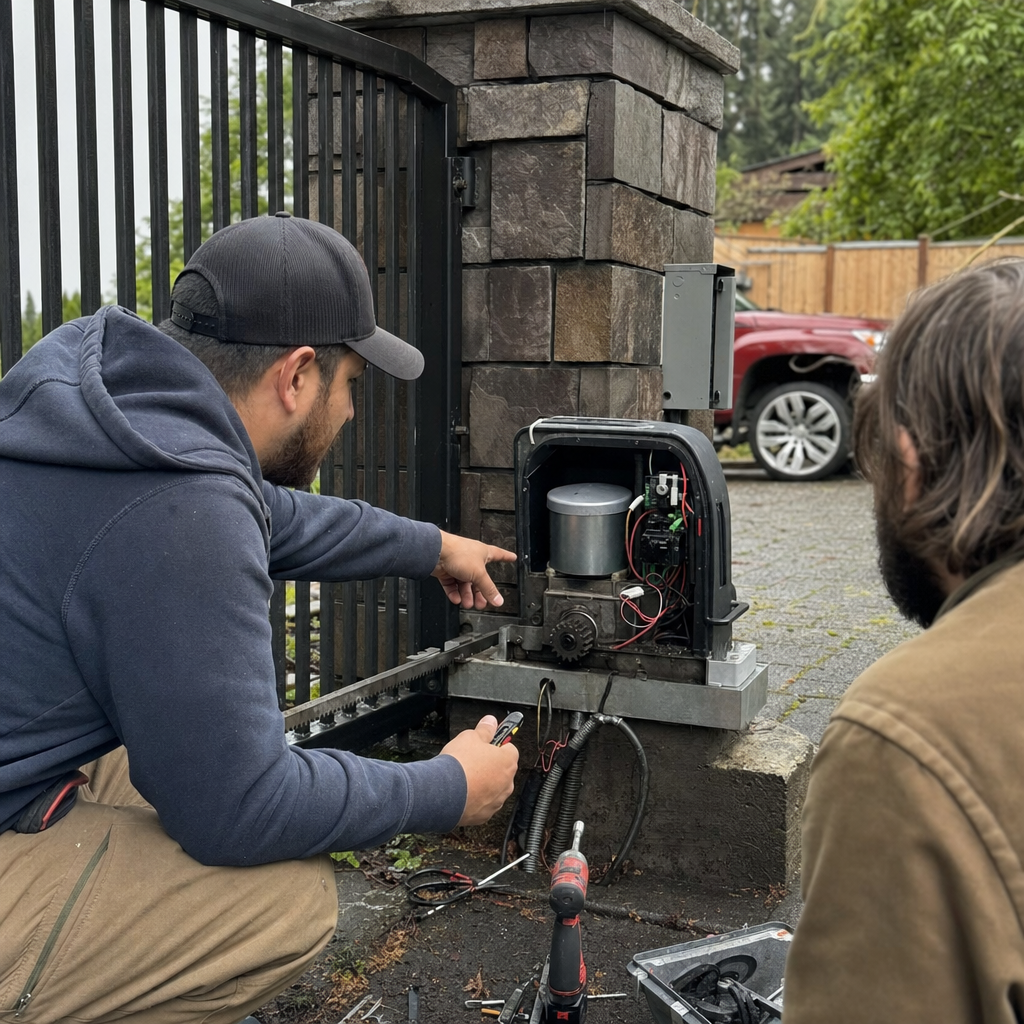
- Transformer or power supply failure. This requires a multimeter to verify, which is where most homeowners stop — and where we come in.
What we don’t recommend: opening the control board enclosure if you smell anything burnt or see discoloration. That’s a call-now situation. (855) 275-6878
Symptom: Gate Starts to Move, Then Stops or Reverses
This pattern almost always points to the safety system, not the motor. The gate’s logic board is detecting an obstacle — real or perceived — and executing its programmed response. The most frequent culprits:
- Photoelectric sensor misalignment. The two sensor housings must “see” each other precisely. A bump from a lawnmower, a shifted post, or even thermal expansion of the mounting bracket can break that alignment by fractions of an inch — enough to read as permanent obstruction.
- Sensor lens contamination. Spider webs, pollen film, leaf residue, or that particular Washington combination of pollen-plus-dew that cakes into a translucent film. Clean with a soft cloth; don’t use solvents that can fog the lens permanently.
- Mechanical binding in the track or hinge. The motor draws more current than expected, the overload protection triggers, and the gate stops. This is where our “from the motor to the weld” capability matters — we can address the mechanical root cause, not just keep replacing motors that are doing their job correctly.
Here’s a brand-specific note that competitors rarely mention: certain LiftMaster and Linear models manufactured in the 2018–2022 range have obstacle-detection sensitivity thresholds that are, frankly, too conservative for leaf-heavy environments like Washington. They’ll interpret a slightly dirty sensor or a minor track irregularity as a hard obstruction and refuse to operate. Knowing this prevents the unnecessary motor replacements we’ve seen other services recommend. We work on the brand you already have — including factory familiarity with LiftMaster, Linear, and seven other major systems — so we can recalibrate or bypass that sensitivity issue without telling you to replace a perfectly good unit.
Symptom: Gate Beeps or Clicks, But Doesn’t Move
This is the auditory signature of a motor that’s receiving power and command signals but can’t execute mechanical motion. The diagnostic split:
- Physical obstruction. Something is physically blocking travel — debris in the track, a shifted gate leaf, ice buildup in winter.
- Failed motor capacitor or starter. The motor “wants” to turn but lacks the torque to overcome initial resistance. Common in gates that haven’t been serviced in 3+ years.
- Stripped drive component. Rack-and-pinion systems can strip teeth; chain drives can break or jump sprocket; screw drives can bind or fracture. Each has distinct audible signatures we’ve learned to identify in 14 years of gate-only work.
The beep pattern itself often encodes information. Many FAAC and BFT systems use beep sequences to indicate specific fault codes — two beeps for this, three for that. If you can capture the pattern on video, it accelerates our diagnosis significantly when you call.
Symptom: Remote Stopped Working, But Manual Release Functions Normally
This is the most reassuring failure pattern because it isolates the problem to the control/signal path, not the mechanical system. The hierarchy:
- Remote battery. Obvious, but genuinely overlooked in about 30% of cases. CR2032 batteries die without warning.
- Remote desynchronization. Power outages, electrical storms, or even nearby RF interference can knock a remote out of sync with the receiver. Re-pairing procedures vary by brand — Mighty Mule’s process differs from DoorKing’s, for instance — but all are documented and straightforward.
- Receiver antenna damage or misplacement. The receiver’s antenna needs clear line-of-sight to the remote’s transmission zone. Metal enclosures, new landscaping, or even a relocated vehicle can create RF shadows.
- Receiver board failure. Less common but not rare in systems older than ten years. This is a component-level repair we handle regularly.
What You Can Safely Check — And When to Stop and Call
We’re not interested in charging you for a service call you didn’t need. Here are five checks any homeowner can perform without tools or electrical exposure:
- Verify power at the outlet or disconnect. Plug a known-working device into the same outlet, or check that the disconnect switch hasn’t been turned off.
- Inspect and clean safety sensors. Look for obvious misalignment, debris, or lens film. Adjust gently if bumped; don’t force.
- Check the manual release status. Ensure it’s fully in the “automatic” position.
- Test the remote battery. Replace with a fresh battery of the correct type.
- Look for visible track obstructions or physical damage. Clear debris; note any new dents, bends, or shifted posts.
And here are the two conditions where continuing to troubleshoot risks injury or further damage — stop and call (855) 275-6878 immediately:
- Visible sparks, burning smell, or scorched components in the control enclosure. This indicates active electrical fault. Do not open the enclosure; do not cycle power repeatedly.
- Gate moving erratically — jerking, speeding up, or reversing unpredictably. This suggests a control board or safety system failure that could cause the gate to strike a person or vehicle without warning. Automatic gates exert significant force; a malfunctioning gate is dangerous.
If I wouldn’t trust the fix on my own property, I’m not leaving it on yours.
When Weather Is the Real Culprit: Washington’s Seasonal Gate Patterns
We’ve been tracking failure patterns across Washington for 14 years, and they’re not random. Here’s what we see by season:
| Season | Most Common Failure | Typical Cause |
|---|---|---|
| Spring (Mar–May) | Sensor misalignment / pollen contamination | Heavy pollen coats lenses; rapid temperature shifts loosen mounting hardware |
| Summer (Jun–Aug) | Moisture intrusion in control boards | Humidity + temperature cycling creates condensation in enclosures |
| Fall (Sep–Nov) | Leaf/debris obstruction of sensors and tracks | Canopy drop peaks; wind events increase |
| Winter (Dec–Feb) | Frame binding / track ice / motor overload | Freeze-thaw cycles shift metal frames; ice formation in low spots |
The fall pattern is particularly predictable in neighborhoods with mature tree cover — Chevy Chase, Takoma, Forest Hills, and similar. We’ll often receive multiple calls from the same block after a wind event, not because the gates are poorly maintained, but because the environmental load exceeded the design margin of 15–20-year-old installations.
Winter failures in low-lying areas near the Anacostia or Potomac frequently trace to moisture that entered the system in summer and crystallizes into conductive paths or physical expansion damage by January. The gate that “suddenly” failed in February usually started failing in August; the owner just didn’t notice the intermittent hesitation or occasional false obstruction trigger.
What Professional Diagnosis Actually Involves — And What It Costs in Washington
When self-checks don’t resolve the issue, the next step is systematic diagnosis by someone who understands gate systems as a primary trade, not a sideline. Here’s how we approach it, and what Washington homeowners typically invest:
- Service call and diagnostic assessment: $95–$145. This covers travel within Washington, full electrical and mechanical evaluation, and a written finding with repair options. If you proceed with the repair, we apply this toward the total.
- Sensor realignment or replacement: $85–$180 depending on whether the existing hardware is salvageable and if wiring needs repair.
- Control board repair or replacement: $280–$650. We always attempt component-level repair first; replacement is only when the board is genuinely unrecoverable or obsolete.
- Motor repair or replacement: $340–$890. Range depends on motor size, brand parts availability, and whether the failure is in the motor itself or a replaceable subcomponent like the capacitor or gearbox.
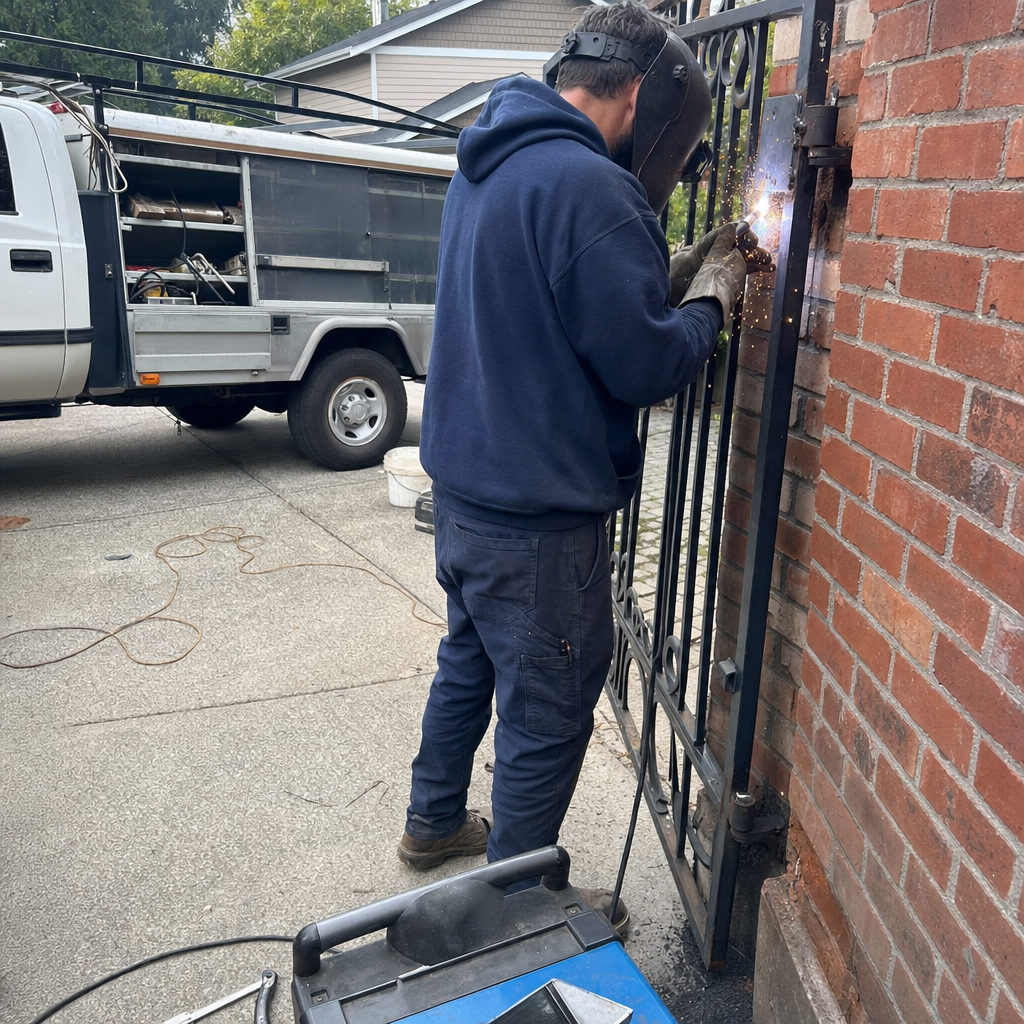
- Track or frame welding and realignment: $220–$580. This is where our structural welding capability matters — we don’t subcontract this out or tell you to call a separate ironworker.
These ranges reflect Washington’s market — parts and labor costs here run moderately above national averages due to logistics and regulatory factors, but not at the premium levels of San Francisco or Manhattan. We provide upfront pricing before any work begins; no surprises, no “while we were in there” add-ons.
Nearly 900 neighbors agree that this approach works. Our 869 verified reviews at a 4.7-star average reflect 14 years of showing up, diagnosing honestly, and fixing what we said we’d fix. David diagnoses it himself on every job — there’s no dispatch layer between your description of the problem and the person who’ll actually be working on your gate.
FAQs
The remote light only confirms that the remote is transmitting — it doesn’t confirm that the gate’s receiver heard the signal, that the control board processed it, or that the motor can execute the command. Start by checking whether the gate responds to the hardwired keypad or indoor button; if those work, the problem is likely the receiver or remote pairing. If nothing works, the issue is upstream — power, control board, or safety system lockout. Call (855) 275-6878 for a quick diagnostic — estimates are free.
For gates under 12 years old with quality original components, repair is almost always the more economical path — typically 30–50% of replacement cost. For gates over 15 years with multiple failing subsystems or obsolete parts, replacement becomes the better long-term value. We don’t sell gate systems; we repair them. So when we recommend replacement, it’s because the math genuinely favors it, not because we’re chasing a bigger ticket. David will walk you through the specific numbers for your setup.
Same-day service is available for most Gate Repair in Washington calls placed before noon, and for all emergency situations involving security exposure or vehicle entrapment. Our standard scheduling runs 24–48 hours for non-urgent issues. We stock common components for LiftMaster, Linear, FAAC, and BFT systems, which covers the majority of Washington residential installations.
The fastest self-test: engage the manual release and try to move the gate by hand. If it moves smoothly through its full travel, the problem is almost certainly electrical — control board, motor, sensors, or power supply. If it binds, grinds, or won’t budge manually, the issue is mechanical — track, hinges, frame, or drive hardware. This single test eliminates half the diagnostic tree immediately. If you’re unsure what you’re feeling, call us at (855) 275-6878 and describe it — we can usually narrow it down over the phone.
When You’re Ready to Stop Guessing
Fourteen years and one trade. That’s the difference between a technician who recognizes your failure pattern in the first two minutes and one who replaces parts until something works. If your automatic gate won’t open and the self-checks haven’t revealed the cause, Gate Repair from Liberty Bell Gate Repair Washington gives you David Martinez’s hands-on diagnosis — not a call-center script, not a subcontractor’s best guess.
We work on the brand you already have. From the motor to the weld. And we stand behind it.
If you’d rather have it looked at, Liberty Bell Gate Repair Washington offers a no-pressure assessment in Washington — call (855) 275-6878 for a free estimate.
Written by David Martinez, Owner & Lead Technician at Liberty Bell Gate Repair Washington, serving Washington, WA.