
Electric Gate Repair Cost in Washington, WA: What You’ll Actually Pay in 2024
Electric gate repair in Washington, WA typically runs $195–$650 for most residential jobs, with simple sensor realignments starting around $150 and control board replacements reaching $800+. Call (855) 275-6878 for a free, itemized estimate on How Much Does Gate Repair Cost? (2026 Price Guide) — Washington, WA—David Martinez, our owner and lead technician, diagnoses every job personally. The biggest cost surprise most Washington homeowners face isn’t the repair itself; it’s paying twice because the first technician misdiagnosed an electrical problem as a mechanical one, or vice versa.
Why Washington’s Housing Stock Makes Gate Diagnosis Trickier
Washington’s residential landscape is a patchwork of eras. You’ve got the sturdy brick colonials of Chevy Chase and Takoma Park built in the 1940s and 50s, the mid-century ramblers spreading through Silver Spring, and the newer infill developments popping up around Navy Yard and the Wharf. Each era brings its own electrical personality to your gate system.
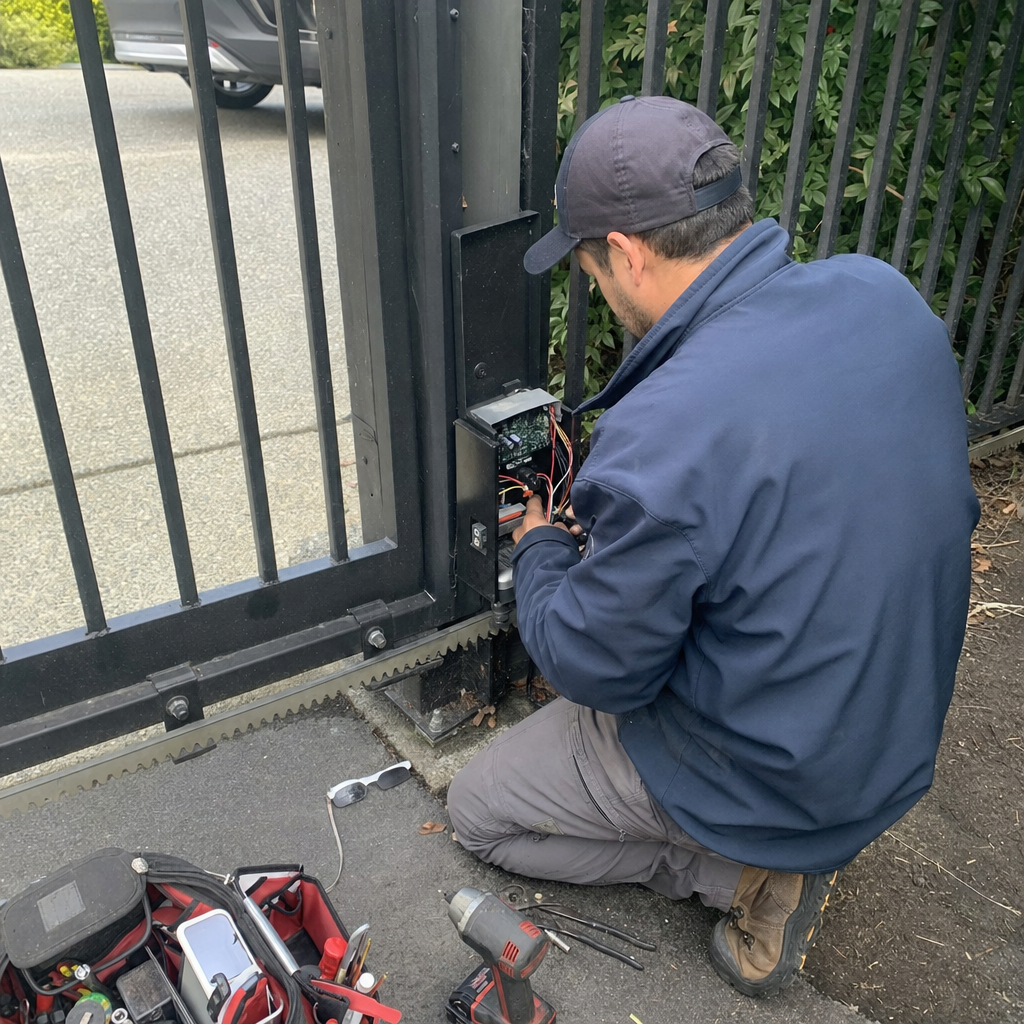
We’ve spent 14 years crawling behind control boxes in this city, and here’s what keeps showing up: older Washington properties frequently have undersized or ungrounded circuits feeding the gate location. The homeowner calls us because their LiftMaster or Mighty Mule operator keeps “randomly” failing—stopping mid-cycle, throwing error codes that clear themselves, or simply refusing to respond until the next morning. A generalist tech sees the intermittent pattern, swaps the logic board for $400–$600, and the problem returns three weeks later. We see it differently. David carries a multimeter on every diagnostic call because we’ve learned to verify voltage stability under load before we blame any component. In Washington’s older neighborhoods, that circuit test alone has saved customers from unnecessary board replacements at least a dozen times in the past year.
The humidity doesn’t help either. Washington summers hang heavy and wet, and we’ve tracked corrosion failures in outdoor-rated enclosures that technically should’ve held up. It’s not the gate brand’s fault—it’s that “outdoor-rated” assumes occasional rain, not the persistent moisture that settles into low-lying areas near Rock Creek Park or along the Anacostia. We factor that into our diagnostic time, checking terminal connections and grounding integrity that a rushed technician might skip.
Electrical vs. Mechanical Failures: The Cost Split Nobody Explains
Here’s the distinction that determines your final bill. Most “electric gate repair” pages throw out one generic number. We don’t, because the two failure types require completely different expertise, parts, and time investments.
Electrical system failures involve the brain and nervous system of your gate: control boards, transformers, wiring runs, safety sensor loops, and photocells. These failures often present as erratic behavior—partial opening, random reversing, or complete non-response with no visible physical damage.
Mechanical failures are the muscles and bones: actuators, drive gears, hinge pins, track wheels, and the physical gate structure itself. These announce themselves with grinding, binding, visible wear, or the gate physically stuck in position.
The diagnostic trap? Electrical problems can mimic mechanical ones. A failing transformer delivering low voltage makes an actuator struggle, which sounds like a worn gear. A misaligned safety sensor can cause the same stuttering behavior as a damaged drive component. We’ve inherited plenty of “unfixable” gates in Washington where the previous technician replaced mechanical parts while the real culprit was a $45 transformer or a corroded ground wire.
That’s where 14 years of single-trade focus pays off. David doesn’t guess—he tests. And because we’re factory-familiar with nine major brands including LiftMaster, FAAC, and Elite, we pull the actual wiring schematic for your specific model rather than working from generic assumptions. That specificity compresses diagnostic time, which directly lowers your labor cost.
Typical Electric Gate Repair Costs in Washington
| Repair Category | Specific Issue | Parts & Labor Range |
|---|---|---|
| Electrical System Repairs | Safety sensor realignment or replacement | $150–$280 |
| Transformer replacement | $180–$320 | |
| Control board replacement (standard residential) | $380–$650 | |
| Control board replacement (heavy-duty/commercial) | $550–$850 | |
| Mechanical System Repairs | Hinge pin and bushing replacement | $195–$340 |
| Actuator arm repair or replacement | $320–$580 | |
| Drive gear or sprocket replacement | $280–$450 | |
| Track wheel or roller replacement (sliding gates) | $220–$390 | |
| Diagnostic service call (applied to repair if approved) | $95–$145 | |
| Emergency/same-day premium (when available) | +25–40% | |
These ranges reflect what we actually charge Washington homeowners in 2024. They’re not theoretical national averages—they’re our invoices, averaged across the past 18 months of jobs from Shepherd Park to Hill East.
The Logic Board Trap: Washington’s Most Over-Replaced Part
If there’s one piece of advice we’ve earned the hard way, it’s this: never replace a control board until you’ve ruled out power supply and sensor issues first.
Control boards are the most expensive single component in most residential gate systems. They’re also the easiest to blame. A tech runs out of diagnostic time, sees a board throwing codes, and swaps it. The customer pays $500–$700. Two weeks later, the new board fails too—because the root cause was a transformer delivering 22 volts instead of 24, or a safety sensor loop with a nick in the cable that intermittently shorts against the metal frame.
David’s diagnostic sequence is deliberately methodical, and it’s saved Washington customers thousands:
- Step one: Verify input voltage at the operator under load (gate moving), not just at rest. We catch weak transformers this way that show normal voltage until the motor draws current.
- Step two: Test every safety device in the loop individually—photocells, edge sensors, magnetic loops—because one failing device can make the board appear faulty.
- Step three: Inspect all terminal connections for corrosion, especially in Washington’s humid summers and salted winter conditions.
- Step four: Only then evaluate the control board itself, using manufacturer-specific diagnostic procedures for your exact model.
This sequence takes 15–25 minutes longer than a quick “swap and hope” approach. But it prevents the most expensive mistake in gate repair: replacing the wrong thing, then charging you again to find the real problem.
We work on the brand you already have—LiftMaster, DoorKing, Linear, FAAC, Elite, Mighty Mule, and four others—which means we’re not steering you toward replacement because we don’t understand your system. If I wouldn’t trust the fix on my own property, I’m not leaving it on yours.
What a Real Itemized Invoice Looks Like (And Why Lump Quotes Cost You)
We’ve seen competitors in Washington quote “$450 to fix it” with no breakdown. That opacity serves them, not you. Here’s how we structure every electric gate repair estimate:
| Line Item | Typical Range | What It Covers |
|---|---|---|
| Diagnostic/Service Call | $95–$145 | Travel, initial testing, fault isolation; credited toward repair if you proceed |
| Labor (per hour) | $125–$175 | Actual time on repair, not rounded-up blocks; most jobs 1–2.5 hours |
| Parts | Cost + 20–30% | Exact replacement components, sourced through authorized distributors for warranty coverage |
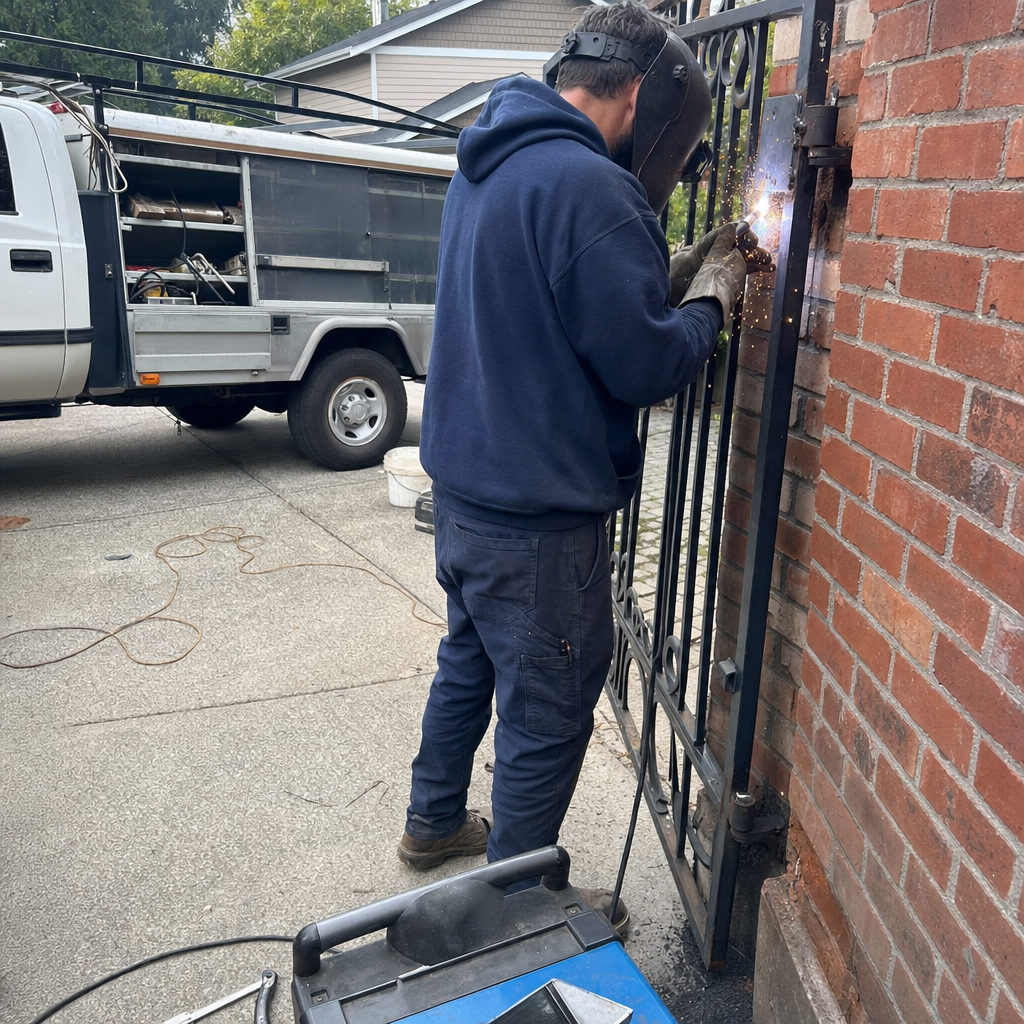
| Structural/Welding (if needed) | $180–$400 | Gate frame repair, post reinforcement, hinge re-welding—our in-house capability, not subcontracted |
The lump-quote approach hides markup and prevents comparison. Our itemized method lets you see exactly where your money goes—and lets you make informed decisions about repair vs. replacement when the numbers get close.
That “repair vs. replacement” threshold matters. For a 12-year-old operator with a failed board, a $600 repair on a system with other worn components often doesn’t make sense. We’ll tell you that straight, because 14 years in one trade has taught us that a customer who trusts our honesty calls us for the next job, and the one after that. Nearly 900 neighbors agree—our 869 reviews at 4.7 stars come from people who’ve experienced that transparency directly.
When Should You Repair vs. Replace Your Electric Gate System?
This is the question behind most cost searches, even when people don’t phrase it that way. Here’s our practical framework:
Repair makes sense when: The failure is isolated to one component, the gate structure itself is sound, and the system is under 10–12 years old. A single sensor, transformer, or actuator replacement on a well-maintained gate typically returns years of reliable service.
Replacement becomes the better value when: You’re facing multiple concurrent failures, the operator is past manufacturer parts availability, or the gate structure has sagging, corrosion, or alignment issues that will stress any new components. We’ve seen Washington homeowners sink $800 into electrical repairs on a gate whose twisted frame was destroying actuators every 18 months. The honest math favors replacement in those cases.
David makes that call himself on every job—no commission-driven upsell, no junior tech guessing. From the motor to the weld, we assess the full system because partial fixes on failing infrastructure waste your money.
Safety Note: Live Electrical and Moving Gate Components
Electric gate systems combine two genuine hazards: live electrical circuits (often 120V or 240V at the primary, 24V low-voltage at the control) and high-tension mechanical components that can crush or shear. Gate operators store energy in springs and counterweights that don’t care if you’ve unplugged the unit. We’ve responded to Washington calls where a homeowner’s DIY attempt triggered a board failure—or worse, a physical injury—because they didn’t recognize the stored energy in the actuator arm. If you’re not trained to lock out and verify zero energy state on your specific system, call a professional. The diagnostic fee is always cheaper than an ER visit or a completely destroyed operator.
FAQs
Most Gate Repair Near Me in Washington, WA services handle residential electric gate repairs that fall between $195 and $650, with simple fixes like sensor realignment at the lower end and control board replacement at the higher end. Commercial-grade systems or multiple concurrent failures can push toward $800–$1,200. Call (855) 275-6878 for an exact quote—estimates are free, and our diagnostic fee applies toward the repair if you proceed.
Repair is cheaper for isolated failures on systems under 10–12 years old, but replacement saves money long-term when the gate structure is failing or parts are obsolete. We evaluate the full system—electrical, mechanical, and structural—before recommending either path, because a $600 board replacement on a twisted frame that eats actuators every 18 months is false economy. Call (855) 275-6878 and we’ll walk through the actual numbers for your situation.
We offer same-day service throughout Washington when scheduling allows, with Emergency Gate Repair in Washington, WA for security-critical situations like gates stuck open or completely non-functional entry systems. Same-day and emergency calls carry a 25–40% premium over standard scheduling. Call (855) 275-6878 to check today’s availability—David handles the dispatch directly, so you’ll get an honest answer about timing, not a call-center promise.
The control board is the most over-replaced component in gate systems because it’s easy to blame and expensive to swap, but boards often fail symptomatically due to underlying power supply or sensor issues. We test voltage under load, verify every safety device in the loop, and inspect connections for corrosion before condemning any board—steps that add 15–25 minutes to diagnosis but prevent the $500–$700 mistake of replacing the wrong part. If you’ve already paid for a board replacement that didn’t stick, call (855) 275-6878; we’ll diagnose the real cause and apply that knowledge to fix it properly.
Get Your Exact Electric Gate Repair Estimate in Washington
Stop guessing at costs based on generic ranges that don’t account for your specific gate, your Washington property’s electrical quirks, or whether you’re dealing with a real component failure or a misdiagnosis. David Martinez, Owner & Lead Technician at Liberty Bell Gate Repair Washington, handles every diagnostic call personally—14 years of gate-only expertise, 869 verified reviews, and the accountability of someone whose name is on the business. Call (855) 275-6878 now for your free, itemized estimate. We’ll show up, test thoroughly, and tell you exactly what your repair will cost before any work begins.
Written by David Martinez, Owner & Lead Technician at Liberty Bell our Gate Repair services Washington, serving Washington, WA.
What Our Customers Say
"Solar panel on our remote gate wasn't keeping the battery up through the winter. He repositioned it, replaced the battery, and explained the math on why the old placement was never going to work."
— Heather Anderson"We had a hydraulic arm leaking fluid onto the driveway. Replaced, cleaned up the stain as best he could, and it's been dry for months."
— Greg Padgett"Control board fried after a lightning storm. He showed me the burn mark on it, quoted the board, and installed a surge protector on the line so it hopefully doesn't happen again."
— Roger Schaefer