
Last updated September 3, 2026
Seasonal Gate Repair Care for Seattle: Year-Round Homeowner’s Guide
The most expensive our Gate Repair services handle every year get scheduled in July — not because summer is hard on gates, but because homeowners discover in July what late April’s soil movement quietly broke. Seattle’s wet winters and dry summers create a hidden damage window that most gate care guides completely miss. After 14 years of diagnosing gate failures across Capitol Hill, Ballard, West Seattle, and the Eastside, I’ve learned that timing your maintenance to our specific climate patterns saves thousands in preventable repairs. This guide assigns the right tasks to the right season — and explains why late spring is the most dangerous period for your gate’s structural integrity.
Quick Answer
Seattle homeowners should perform gate maintenance using our Gate Repair Maintenance Checklist for Seattle Homeowners on a seasonal rhythm: fall debris clearing before the wet season, winter battery and lubrication checks for automatic operators, late spring structural inspection after soil movement peaks, and summer repairs during dry conditions when welding and concrete work cure properly. The highest-risk window for gate damage in Seattle is late March through May, when saturated clay soils shift post footings and stress hinges before homeowners notice the problem.
Table of Contents
- Late Spring: The Hidden Damage Window (March–May)
- Summer: Structural Repairs and Full Inspection (June–August)
- Fall: Pre-Wet-Season Debris Protocol (September–November)
- Winter: Automatic Gate Operator Survival (December–February)
- How to Spot “Seasonal Creep” Before It Fails
- Common Mistakes to Avoid
- When to Call a Professional
- Frequently Asked Questions
Late Spring: The Hidden Damage Window (March–May)
Here’s what the generic guides won’t tell you: Seattle’s clay-heavy soils — particularly in neighborhoods like Magnolia, Queen Anne, and the Ravenna-Bryant ridge — hold moisture through winter and reach peak saturation in late March and April. When that moisture begins to evaporate through May, the soil contracts unevenly. Gate posts that were plumb in October tilt microscopically. Hinges that rotated freely develop binding stress. By the time you notice the gate “seems a little stiff,” the damage is already done.
I’ve replaced more twisted gate frames in July than any other month — always tracing the failure to a post that shifted in April and was ignored through June. The homeowner opens the gate on a warm Saturday, hears a pop, and suddenly the frame is racked beyond repair.
What to do in late spring:
- Check post plumb with a level. Stand at each post and sight down the face. Any lean toward or away from the gate swing is meaningful. Even 1/4 inch at post height translates to significant hinge stress.
- Inspect hinge bolts for fresh rust streaks. Rust bleeding from bolt heads indicates movement — the bolt is working against its hole.
- Cycle the gate manually (disconnected from operator). It should swing smoothly through its full arc. Any catch, grind, or dead spot in the motion is a warning.
- Look for new gaps between gate and post, or gate and ground. A gate that scraped in summer but clears in spring has likely shifted. The opposite — a gate that suddenly scrapes — means the frame is twisting under stress.
- Photograph the gate closed. Compare to a photo from the previous fall. Visual memory is unreliable; pixels don’t lie.
If you find movement, don’t wait for summer to address it. A post that’s shifting in spring will continue shifting until it’s stabilized. In our experience, catching post movement in April versus July typically means the difference between a $280 hinge adjustment and a $1,400 frame replacement.
For automatic gates, this is also when to test your Gate Motor & Opener in Tacoma equivalent systems — the added load of a binding gate will burn out a motor fast. We’ve replaced Viking and Ghost Controls operators that failed not from motor defects, but from months of compensating for a spring-shifted gate.
Summer: Structural Repairs and Full Inspection (June–August)
Summer is Seattle’s repair season, and not just because the weather is pleasant. Dry conditions matter for specific technical reasons that directly affect repair quality and longevity.
Why dry conditions matter:
- Concrete and grout curing: Post stabilization with concrete or epoxy requires consistent low-moisture conditions. Pouring in saturated soil traps moisture and weakens the bond. We schedule all post-setting work for July and August when possible.
- Welding quality: Structural welding on steel gates requires dry metal and controlled cooling. Moisture on the workpiece causes porosity — tiny voids that become crack initiation points. A frame repair done in August lasts longer than the same repair done in March.
- Paint and coating adhesion: Rust remediation and protective coating application need 48 hours of dry weather to cure properly. Seattle’s summer delivers this reliably; other seasons do not.
- Soil stability for assessment: When soil is at its driest, you see the true resting position of posts. A post that leans in August is genuinely failing, not just responding to temporary moisture.
This is the season for elective work you’ve been postponing: hinge replacement, frame straightening, operator upgrades, access control additions. The Gate Installation in Tacoma and Seattle markets both see peak demand in August, so schedule early if you’re planning significant work.
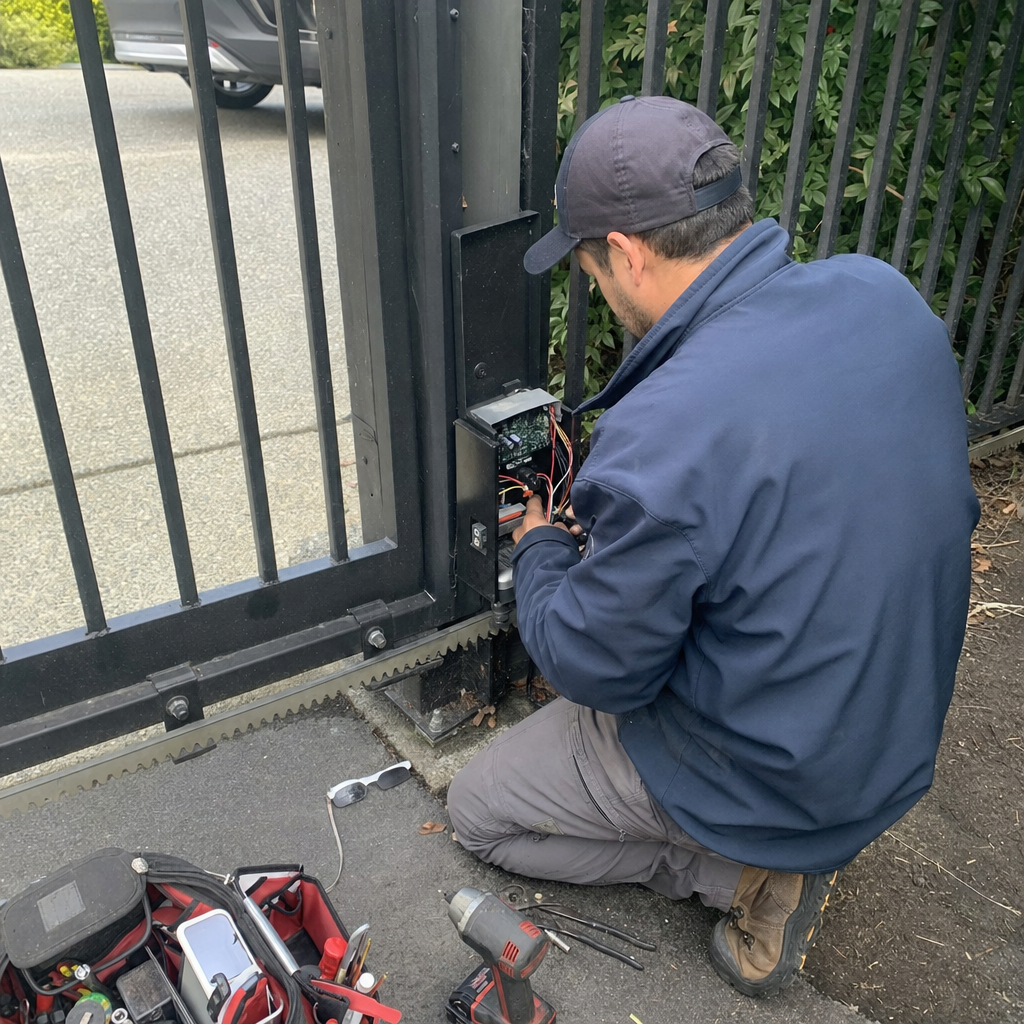
For property managers in Seattle’s multifamily buildings, summer is when we perform full-spectrum assessments — from the motor to the weld, as we say. David diagnoses these himself, walking the full perimeter, checking each Liberty Bell Gate Repair Washington home system component for wear patterns that predict failure. After 14 years, one trade, the patterns are unmistakable: a particular squeak in a DoorKing chain drive, a specific hesitation in an Elite slide gate that means the limit switch is failing.
One task often overlooked: summer is ideal for vegetation management. Cut back anything within 18 inches of gate travel. Seattle’s Himalayan blackberries grow aggressively through July, and by October they’ll be thick enough to jam track systems or mask developing rust.
Fall: Pre-Wet-Season Debris Protocol (September–November)
Seattle’s fall isn’t dramatic, but it’s decisive. The return of consistent rain in October, combined with leaf drop from our bigleaf maples and red alders, creates a specific maintenance window that closes fast.
The debris problem: Leaves and needles don’t just look messy. They accumulate in track channels for slide gates, pack into operator housings, and decompose into acidic pulp that accelerates corrosion. Once the wet season truly arrives, this debris becomes saturated and freezes in place — literally, in January cold snaps, but also effectively, as mold and mildews bind it into a solid mass that’s much harder to remove.
Fall maintenance checklist:
- Clear all track channels completely. Use a narrow putty knife or dedicated track tool. Look for the compacted layer at the bottom — surface clearing isn’t enough.
- Vacuum or blow out operator housings. Remove the cover (power off first) and clear leaf fragments, spider webs, and moisture-retaining dust. Check for rodent nesting — common in Seattle’s older neighborhoods with mature tree canopy.
- Inspect drain holes in posts and bottom rails. Clogged drains trap water that freezes and expands. A 1/4-inch drain hole takes thirty seconds to clear; a split post takes hours to replace.
- Apply fresh lubricant to hinges, rollers, and chain drives. Use a cold-weather-rated product — standard lubricants thicken below 40°F and add load to motors. We’ve seen Ghost Controls operators strain and fail on gates with summer-weight lube in January.
- Test all safety systems: photo eyes, edge sensors, auto-reverse function. Shorter daylight hours mean more nighttime operation; safety failures are more dangerous when visibility is reduced.
In neighborhoods like Laurelhurst and Windermere, where mature deciduous trees overhang driveways, we recommend a mid-November follow-up check. One windy November evening can deposit more debris than the entire month of October.
Fall is also when to assess your gate’s weather sealing. Gaps that were tolerable in summer become water intrusion points in winter. For wooden gates specifically — still common in Seattle’s Craftsman neighborhoods — check end-grain sealing. Water wicking into unsealed post tops causes rot that accelerates dramatically through the wet season.
Winter: Automatic Gate Operator Survival (December–February)
Seattle winters are mild compared to the upper Midwest, but they’re wet, dark, and hard on automatic gate systems in specific ways. The temperature rarely drops enough to freeze mechanisms solid, but it hovers in the range where condensation forms inside housings, batteries lose capacity, and lubricants thicken.
Battery backup verification:
Every automatic gate operator we install or service — whether LiftMaster, FAAC, BFT, Linear, Viking, Ghost Controls, DoorKing, Elite, or Mighty Mule — relies on battery backup for safety compliance and power-outlet operation. Seattle’s winter windstorms cause more gate failures through power loss than through mechanical damage.
Test your battery backup monthly in winter: disconnect AC power and cycle the gate twice. If it moves sluggishly or fails to complete a cycle, the battery is degrading. Cold temperatures reduce apparent capacity by 20-30%; a battery that was marginal in September will fail in January.
Replacement is straightforward for most brands, but the specific battery type varies. We’ve seen homeowners install automotive batteries in Elite operators — wrong chemistry, wrong charging profile, guaranteed early failure. When in doubt, check the manual or call for specification.
Cold-weather lubrication specs:
Not all lubricants are equal in winter. Standard lithium greases thicken and increase motor load. For Seattle’s typical winter range (35-45°F), we specify:
- Hinges and rollers: silicone-based spray lubricant with PTFE, rated to 0°F
- Chain drives: specific chain lube, not general-purpose oil — it stays in place and doesn’t fling off at operating temperature
- Rack and pinion systems: dry graphite or specialized rack grease, never oil-based products that attract moisture-laden grit
Ice and snow protocol:
Seattle’s occasional snow events create a specific hazard: melting and refreezing on driveways. Never force a gate against ice buildup — the operator’s torque limit is designed to protect the motor, not the gate structure. Forcing operation can rack the frame or strip drive components. Clear ice manually, then operate. If your gate is in a shaded location where ice persists, consider a heated driveway section or manual operation until conditions improve.
For properties in higher elevations — Cougar Mountain, parts of Issaquah, the Sammamish plateau — winter temperatures drop lower and stay there longer. These locations need more aggressive cold-weather prep, including battery warmers for some operator models.
How to Spot “Seasonal Creep” Before It Fails
“Seasonal creep” is my term for the gate that works fine in August but binds, squeals, or fails in January. It’s one of the most common calls we get, and it’s almost always preventable if caught early.
What seasonal creep looks like:
- Gate opens smoothly in warm weather, but the motor labors or stalls in cold conditions
- Manual operation feels normal in summer, but there’s a catch or dead spot in winter
- Gate closes fully in dry periods, but gaps appear after heavy rain
- Operator limit switches need readjustment seasonally — a sign the gate’s resting position is shifting
- Hinge bolts that were tight in September are loose by March
The actual causes:
Seasonal creep isn’t mysterious. It’s usually one of three mechanisms:
1. Post movement from soil moisture cycling. Seattle’s clay soils expand when wet and contract when dry. A post set in undisturbed native soil may remain stable, but most gate posts are in backfill that wasn’t properly compacted. This fill material moves more dramatically, and it moves seasonally. The post tilts microscopically, the gate frame twists to compensate, and by year three or four, something breaks.
2. Thermal expansion mismatch. Aluminum gates expand roughly twice as much as steel per degree of temperature change. A 10-foot aluminum gate in full sun can change length by 1/8 inch between a 40°F morning and a 75°F afternoon. If the mounting hardware doesn’t accommodate this, something binds or cracks.
3. Moisture absorption in wooden components. Cedar and redwood gates — prized in Seattle for natural rot resistance — still absorb moisture. A gate that was properly sized in summer may swell and bind in winter. Conversely, a gate fitted in winter may gap and rattle come August.
Detection protocol:
Mark your hinge positions with a paint pen in September. Check in January. Any shift is meaningful. Photograph your gate’s closed position monthly — the camera sees what memory normalizes. And listen: a gate that sounds different is different. The change from a smooth motor hum to a strained whine happens gradually, then suddenly.
When David diagnoses seasonal creep, he’s looking at which mechanism is dominant. Soil movement gets post stabilization. Thermal mismatch gets hardware upgrades. Wood swelling gets strategic trimming and sealing. The fix follows the cause — 14 years, one trade, and the pattern recognition that comes with it.
Common Mistakes to Avoid
- Waiting for “the right time” to address spring movement. Seattle homeowners often notice gate issues in April, then defer repairs until summer. By July, a shifted post has stressed the frame beyond straightening. The right time is when you notice it.
- Using pressure washers on automatic operators. The housing gaskets are water-resistant, not pressure-washer resistant. We’ve replaced multiple DoorKing and Viking control boards after “spring cleaning” with high-pressure spray.
- Applying standard WD-40 as a long-term lubricant. It’s a water displacer, not a lubricant. It evaporates and leaves gates squeaking again in weeks. Use products rated for gate hardware loads and outdoor exposure.
- Ignoring the battery until power fails. Seattle’s windstorm season is predictable; battery failures during storms are predictable too. Test before you need it.
- Trimming vegetation only when it’s visibly overgrown. By then, it’s already deposited months of debris in your track. Set a calendar reminder for June and September, not “when it looks bad.”
- Assuming all operators need the same winter prep. A Ghost Controls solar system in Phinney Ridge has different needs than a hardwired Elite system in a shaded Madrona driveway. Read the specific manual, or have someone who knows these nine brands check it.
- DIY welding on load-bearing gate components. Gate frames carry dynamic loads — swinging mass, wind resistance, occasional impact. Field welding without proper penetration and stress-relief creates failure points. This is genuinely dangerous work; the gate that falls on a car or person doesn’t care that you saved $200.
When to Call a Professional
Some gate maintenance is genuinely homeowner-accessible: debris clearing, visual inspection, lubrication, battery testing. But certain conditions warrant professional assessment — not because you’re incapable, but because the cost of getting it wrong exceeds the cost of getting it right.
Call for professional evaluation if: your gate has shifted visibly and the cause isn’t obvious; you hear grinding, popping, or metallic stress sounds from the motor or frame; the gate binds seasonally and you’ve adjusted hinges more than once; you’re considering structural welding, post replacement, or operator upgrade; or your automatic gate lacks current safety compliance (photo eyes, auto-reverse, edge sensors).
Liberty Bell Gate Repair Washington offers free estimates in Seattle — call (855) 275-6878. David Martinez serves as lead technician on every job, so the person assessing your gate has 14 years of hands-on diagnostic experience with the brand you already have, from the motor to the weld. Nearly 900 neighbors agree: depth beats breadth when your security depends on it.
Frequently Asked Questions
Professional seasonal maintenance typically runs $180–$340 for a single residential gate, including inspection, lubrication, safety system testing, and minor adjustments. Structural repairs discovered during maintenance — post stabilization, hinge replacement, frame straightening — are quoted separately before work begins. Call (855) 275-6878 for an exact quote; estimates are free.
Homeowners can safely handle debris clearing, visual inspection, and basic lubrication. However, automatic gate operators involve high-tension springs, electrical components, and crushing hazards that require specific training to service safely. We recommend professional service for any electrical work, structural welding, or spring-related repairs. If you’re unsure, call for a free assessment — we’ll show you what’s safe to DIY and what isn’t.
This is classic seasonal creep, usually caused by thickened lubricant, reduced battery capacity, or post movement from soil moisture changes. In Seattle’s climate, the most common culprit is a combination of all three: a post that shifted in spring, lubricant that thickened in cold weather, and a battery that was already marginal. The gate “works” in summer because conditions mask the underlying problems. Professional diagnosis identifies which mechanism is dominant.
For automatic gates in Seattle’s climate, we recommend professional service every 12 months minimum, with a supplemental inspection in late spring after soil movement peaks. High-use commercial gates or those in exposed locations (windward slopes, unshielded driveways) benefit from 6-month intervals. Manual gates can typically go 18–24 months between professional service if homeowner maintenance is consistent.
Deferring spring-shift diagnosis until summer. By July, a post that tilted in April has often stressed the gate frame beyond repair. The $280 hinge adjustment becomes a $1,400 frame replacement. Second most expensive: using the wrong lubricant in winter, which burns out operators that would otherwise last a decade.
We work on the brand you already have. David is factory-familiar with nine major systems: LiftMaster, FAAC, BFT, Linear, Viking, Ghost Controls, DoorKing, Elite, and Mighty Mule. We’re not limited to one manufacturer’s products, and we don’t default to “replace everything” when a targeted repair solves the problem.
The Bottom Line
Seattle’s gate maintenance isn’t about doing more — it’s about doing the right tasks at the right times. Clear debris before the wet season locks it in place. Test batteries before windstorms demand them. Inspect structure after spring soil movement, when damage is fresh and repairable. Schedule structural work in summer, when conditions support quality. And watch for seasonal creep: the gate that changes with the weather is telling you something, if you’ll listen before July makes it obvious.
Fourteen years in Seattle has taught us that gates fail predictably. The homeowners who avoid expensive surprises are the ones who match their maintenance rhythm to our climate’s actual patterns, not a generic monthly checklist.
Written by David Martinez, Owner & Lead Technician at Liberty Bell Gate Repair Washington, serving Seattle since 2012. For more guides & resources, visit our blog.