Last updated September 3, 2026
The Complete Guide to Gate Repair in Seattle
Most Seattle gate failures aren’t random — they trace back to one of four local conditions that out-of-state guides never mention, and misdiagnosing even one of them means the repair fails within 18 months. We’ve spent 14 years watching gates fail in Ballard, Capitol Hill, West Seattle, and Queen Anne, and the pattern is unmistakable: Puget Sound salt air, expansive clay soils, freeze-thaw cycles, and perpetual moisture create a unique corrosion-and-settlement environment that generic repair advice simply doesn’t address. In this guide, you’ll learn how Seattle’s specific climate and geography damage gates differently than anywhere else in the country, how to spot the real cause behind common symptoms, and why fixing components in the wrong order guarantees you’ll be calling our Gate Repair services again before the next rainy season.
Quick Answer
Gate repair in Seattle typically addresses corrosion from Puget Sound salt air, hinge misalignment from clay soil expansion, or motor failure from moisture infiltration, with most repairs ranging from $180 for basic hinge work to $1,400 for full motor replacement on automated systems. The majority of residential gate issues in Seattle can be diagnosed and repaired same-day by a technician who understands how local soil and weather conditions accelerate wear on specific components. For an accurate assessment of your gate’s condition, Liberty Bell Gate Repair Washington home provides free estimates throughout Seattle — call (855) 275-6878.
Table of Contents
- Why Seattle Gates Fail Differently Than Gates Anywhere Else
- The Four Local Failure Modes Every Homeowner Should Recognize
- How Gate Materials Hold Up in Seattle’s Wet Climate
- DIY Repairs vs. When Seattle Code Requires a Licensed Contractor
- Why Repair Sequence Matters: The Order That Prevents Repeat Failures
- What Gate Repair Costs in Seattle: Real Price Ranges
- How to Choose a Gate Repair Technician in Seattle
Why Seattle Gates Fail Differently Than Gates Anywhere Else
Seattle sits at the confluence of three forces that punish gates harder than almost any major U.S. city: salt-laden marine air from Puget Sound, expansive glacial clay soils that swell and contract with seasonal moisture changes, and a freeze-thaw cycle that runs from November through March even in mild winters. We’ve replaced hinges in Magnolia that looked like they’d been submerged in seawater, and straightened posts in Beacon Hill that had tilted three inches in eighteen months — not from poor installation, but from soil doing exactly what Seattle’s geology predicts it will do.
The salt air issue surprises newcomers. Puget Sound isn’t the open ocean, but its waters carry enough salinity — roughly 2.9% compared to 3.5% in the Pacific — to create a corrosive film on metal components within a mile of the shoreline. In neighborhoods like Alki, West Seattle’s waterfront, and parts of Magnolia, we’ve seen gate hinges and latch hardware develop pit corrosion in as little as three years. Inland cities with similar rainfall but no marine influence typically see double that lifespan on identical hardware.
The clay soil problem is less visible but more destructive. Seattle’s native soils, particularly in the Rainier Valley, Columbia City, and parts of North Seattle, contain high percentages of expansive clays left by ancient glacial Lake Russell and Lake Bretz. These soils absorb winter rainfall and expand, then contract during dry summer spells. A gate post set in this soil experiences constant micro-movement. The result isn’t dramatic — a quarter-inch here, a half-inch there — but it’s enough to gradually torque hinges, stress welded joints, and misalign automated gate tracks until the motor strains, overheats, and fails.
What this means practically: a gate that “just started sticking” in October has often been moving out of alignment since the previous spring. The symptom appears suddenly, but the cause accumulated over months. Generic repair guides that tell you to “just adjust the hinges” miss the foundation issue entirely. We’ve learned — 14 years, one trade — that lasting repair in Seattle requires diagnosing whether the problem is the component, the installation, or the ground beneath it.
The Four Local Failure Modes Every Homeowner Should Recognize
After nearly 900 service calls across Seattle, we can map virtually every gate failure to one of four local conditions. Learning to recognize these saves you from paying for the wrong repair twice.
1. Salt-Air Corrosion on Hardware and Electronics
Corrosion in Seattle doesn’t look like the dramatic rust you see on coastal California gates. Puget Sound’s cooler temperatures and lower salinity create slower, more insidious damage: microscopic pitting on stainless steel surfaces, galvanic corrosion where dissimilar metals contact, and moisture infiltration into circuit boards that shows up as “intermittent” motor failure before total death.
What to check: Are your hinges developing a rough, pitted texture rather than smooth orange rust? Does your gate opener work fine on dry days but fail after heavy rain? Is there white or greenish corrosion at electrical connections? These are salt-air signatures, not normal wear.
2. Clay-Soil Settlement and Post Lean
In Seattle’s clay-heavy neighborhoods, gate posts tilt gradually, often imperceptibly at first. By the time the gate drags or the automatic opener strains, the post may have moved two inches or more. The critical diagnostic question: does the problem worsen after heavy rain and improve during dry spells? That’s soil movement, not hardware failure.
We’ve replaced perfectly good motors in Rainier Beach because the previous technician never checked post plumb. The new motor failed in eight months — not because it was defective, but because it was fighting a structural misalignment every cycle.
3. Moisture Infiltration in Control Systems
Seattle’s average 155 rainy days per year mean gate control boxes, underground loops, and photocell housings face constant moisture pressure. The specific failure pattern: sensors that work in summer but trigger false obstructions in winter; control boards that fail after condensation freezes and expands; keypad buttons that stick or corrode internally.
The fix isn’t always replacement. Often it’s resealing enclosures, relocating vulnerable components, or upgrading to IP65-rated housings that should have been specified for this climate in the first place.
4. Freeze-Thaw Damage to Concrete and Masonry
Even Seattle’s mild winters include enough below-freezing nights to damage improperly specified concrete footings. When water-saturated soil freezes, it expands upward — heaving posts, cracking footing edges, and creating voids that accelerate future settlement. We’ve repaired gates in Crown Hill and Greenwood where the original installer used standard concrete mix without air entrainment, a specification that might pass in San Diego but fails within three Seattle winters.
How Gate Materials Hold Up in Seattle’s Wet Climate
Your gate material choice in Seattle isn’t just aesthetic — it’s a decision about maintenance burden, repair frequency, and realistic lifespan. Here’s what 14 years of Pacific Northwest gate work has taught us about how each material actually performs.
| Material | Typical Seattle Lifespan | Common Failure Mode | Maintenance Requirement |
|---|---|---|---|
| Western Red Cedar | 12–18 years with proper care | Bottom rail rot, joint separation | Restain/seal every 2–3 years; inspect lower joints annually |
| Iron/Wrought Iron | 20–30 years with maintenance | Hinge corrosion, weld rust at joints | Wire brush and touch-up paint annually; full recoat every 5–7 years |
| Aluminum | 25–35 years | Hinge wear at connection points, cosmetic oxidation | Minimal; inspect hardware every 2 years |
| Vinyl/PVC | 15–25 years | UV embrittlement, impact cracking in cold | Clean annually; avoid pressure-washing joints |
Wood gates in Seattle face a specific challenge: our wet climate keeps the bottom rail moisture content above 20% for months at a time, the threshold where fungal decay accelerates. In our experience, cedar gates installed without proper drainage gaps or pressure-treated lower rails show rot at the ground-contact point within 6–8 years — not because cedar is poor wood, but because Seattle’s moisture profile exceeds what standard construction details handle.
Iron gates present the opposite problem. The material itself is durable, but Seattle’s salt air attacks the maintenance layer — paint, powder coat, or galvanizing — faster than inland climates. We’ve found that iron gates within a mile of Puget Sound need repainting on a 4–5 year cycle, not the 7–10 years typical in drier regions. Once the protective layer is breached, corrosion accelerates exponentially, and repair costs shift from cosmetic touch-up to structural welding and component replacement.
Aluminum’s popularity in Seattle makes sense: it doesn’t rust, it handles our moisture without degradation, and modern alloys have sufficient strength for residential applications. The catch is at connection points. Aluminum’s softness means hinge bolts and latch hardware can wallow out their mounting holes over time, especially on heavy gates where the material flexes. We’ve repaired aluminum gates in Queen Anne where the original installer used steel hardware without isolation washers, creating galvanic corrosion that seized bolts solid.
DIY Repairs vs. When Seattle Code Requires a Licensed Contractor
Some gate repairs are genuinely within capable homeowner range. Others trigger Gate Repair Permits, Codes & Inspections in WA: What You Need to Know requirements that carry real consequences — permit violations, insurance complications, and safety liability — if done without proper licensing.
Repairs Generally Suitable for DIY
- Replacing gate latch hardware with identical specifications
- Adjusting hinge tension on manually operated gates
- Cleaning and lubricating track systems
- Replacing remote control batteries and reprogramming remotes
- Touch-up painting of non-structural surfaces
When Seattle Code Requires a Licensed Professional
- Electrical work on automated gates: Seattle Municipal Code Title 22 requires licensed electrical work on any circuit over 50 volts. This includes wiring to gate motors, control boxes, and safety sensors. DIY electrical work on automated gates voids homeowner’s insurance if fire or injury results.
- Structural welding: Any load-bearing weld repair — hinge brackets, post caps, frame joints — requires a certified welder per Seattle Building Code. We’ve seen homeowner welds fail catastrophically when original cracks weren’t properly prepared or when dissimilar metals were joined without proper filler selection.
- Concrete footing work: New post footings or repair of existing footings deeper than 12 inches require inspection and must meet seismic specifications in Seattle’s Zone 4 earthquake designation.
- Modifications to shared property line gates: Seattle’s fence and gate codes (SMC 23.44) specify height, setback, and access requirements that affect permit status.
The practical boundary: if your repair involves tools you don’t already own for other projects, or if you’re considering watching a YouTube video to learn a technique, that’s a signal to call a professional or follow our guide on How to Hire a Gate Repair Contractor in Seattle: A Step-by-Step Guide. We’ve been called to fix DIY hinge replacements in Green Lake where the homeowner used deck screws rated for shear loads — they failed in six months because gate hinges generate complex stress patterns that require specific fastener grades.
Safety note: Automated gates generate significant force — a typical residential swing gate operator produces 500–1,000 pounds of thrust. The entrapment and crushing risk is real, particularly for children and pets. Seattle code requires specific safety sensor configurations that DIY installers frequently omit or miswire. If your automated gate lacks functioning photo eyes and edge sensors, it’s not just non-compliant — it’s dangerous.
Why Repair Sequence Matters: The Order That Prevents Repeat Failures
This is the mistake we correct most often: a technician fixes the symptom, not the cause, or fixes causes in the wrong order. The result is a repair that holds for months, then fails again — and the homeowner blames the component, not the diagnosis.
Here’s the sequence we’ve developed over 14 years in Seattle, and why each step depends on the one before it (our full Gate Repair Maintenance Checklist for Seattle Homeowners covers this in detail):
- Assess and correct foundation/post plumb first. No hardware adjustment, motor replacement, or track repair will last if the post moves. We check plumb with a 4-foot level, verify footing integrity, and address soil conditions before touching anything above grade. In Seattle’s clay soils, this sometimes means installing a deeper footing, adding drainage rock, or specifying a helical pier for heavy automated gates.
- Restore frame square and gate alignment. Once posts are stable, we measure diagonal frame dimensions and hinge alignment. A gate that’s even 1/4-inch out of square creates uneven hinge loading that accelerates wear and strains automatic operators. We weld, grind, or shim as needed — David diagnoses it himself, and when welding is required, we do it in-house rather than subcontracting.
- Service or replace hardware with Seattle-appropriate specifications. Hinges, latches, and rollers get specified for corrosion resistance: stainless steel or hot-dip galvanized for salt-air exposure, sealed bearings for moisture resistance, proper load ratings for actual gate weight (not the original estimate, which often didn’t account for water absorption in wood gates).
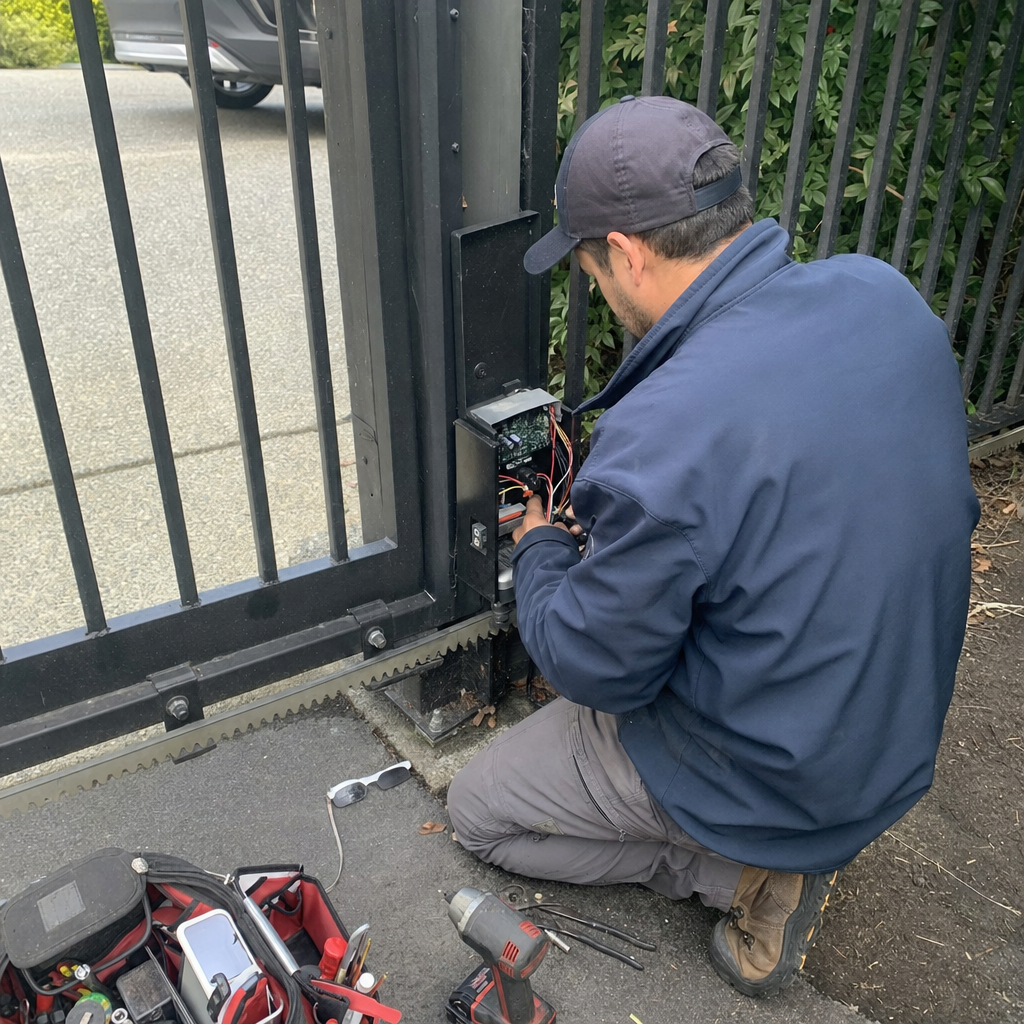
- Address automation and controls last. Motors, openers, and access control systems only get evaluated after the mechanical system is correct. Installing a new FAAC or Linear operator on a misaligned gate guarantees premature failure — we’ve replaced operators that died in 14 months because they were fighting structural resistance every cycle.
The cost of wrong-sequence repair is steep. We’ve documented cases in Capitol Hill and Ballard where homeowners spent $800 on a new motor, then $1,200 on post and frame correction when that motor failed, when doing the foundation work first would have preserved the original motor or guided an appropriate replacement specification.
What Gate Repair Costs in Seattle: Real Price Ranges
These ranges reflect our actual 2024–2025 pricing for Seattle-area service calls, including diagnostic time, materials, and labor. Every gate is different — call (855) 275-6878 for a free estimate on your specific situation.
| Repair Category | Typical Range | What Affects Price |
|---|---|---|
| Basic hinge adjustment/replacement | $180–$340 | Number of hinges, corrosion severity, access difficulty |
| Post straightening or stabilization | $450–$890 | Soil condition, footing depth, need for new concrete |
| Gate frame weld repair | $320–$650 | Weld length, material type, finish restoration |
| Track cleaning and roller replacement (sliding gates) | $280–$520 | Track length, roller count, debris accumulation |
| Gate motor/opener repair | $340–$680 | Brand, component availability, control board vs. mechanical issue |
| Gate motor/opener replacement | $1,100–$2,400 | Gate weight/size, brand (we work on the brand you already have), safety sensor requirements |
| Access control keypad/repair | $220–$480 | Wired vs. wireless, keypad vs. card reader, integration complexity |
| Full automation system upgrade | $2,800–$5,500 | Gate size, access methods, safety features, smartphone integration |
Seattle-specific cost factors: salt-air corrosion often requires hardware replacement rather than adjustment, increasing material costs 15–25% compared to inland markets. Clay soil conditions may require deeper footings or specialized post stabilization, adding labor time. Permit requirements for electrical and structural work add city fees and inspection scheduling.
We provide upfront pricing before beginning work — no surprises, no “while we were in there” add-ons. Estimates are free.
How to Choose a Gate Repair Technician in Seattle
The gate repair market in Seattle includes three distinct provider types, and the difference matters for repair quality and longevity.
General handyman services often list gate repair among dozens of skills. The typical pattern: they can replace a hinge or adjust a latch, but lack the welding equipment, electrical licensing, or brand-specific diagnostic tools to address root causes. We’ve been called after handyman repairs in Wallingford and Fremont where the “fix” masked a developing problem for 18 months, then failed catastrophically.
Franchise operators bring more structure but less flexibility. Their technicians are often entry-level employees following scripted diagnostics, and many are restricted to specific product lines — “we only install our brand” — which means replacement rather than repair when they encounter unfamiliar equipment. We work on the brand you already have: FAAC, BFT, Linear, Viking, and five others, so repair is always an option before replacement.
Specialist owner-operators represent the third model. The person diagnosing your gate has direct accountability for the outcome, and typically carries deeper expertise in the specific failure modes of your local environment. At Liberty Bell Gate Repair Washington home, David Martinez serves as lead technician on jobs — customers get 14 years of hands-on gate expertise, not an entry-level sub dispatched by a call center.
Questions to ask any prospective technician:
- Do you hold electrical licensure for automated gate work in Seattle?
- What gate brands are you factory-familiar with?
- Will you check post plumb and footing condition before quoting hardware or motor work?
- Do you perform structural welding in-house, or subcontract?
- What’s your warranty on labor versus materials?
The answers reveal whether you’re getting symptom treatment or root-cause repair. Nearly 900 neighbors agree — our review volume reflects consistent outcomes, not a handful of selected testimonials.
Common Mistakes to Avoid
- Replacing a motor without checking post alignment: In Seattle’s clay soils, a tilting post creates resistance that burns out even new operators. We’ve replaced motors that failed because the previous technician never checked plumb — a $1,200 mistake that a 2-minute level check would have prevented.
- Using interior-grade hardware on exterior gates: Seattle’s moisture profile requires stainless steel, hot-dip galvanized, or specifically coated fasteners. Standard zinc-plated hardware corrodes through in 2–3 years, not the 10+ years homeowners expect.
- Ignoring drainage at gate post footings: Water pooling around post bases accelerates rot in wood, corrosion in steel, and frost heave in concrete. We see this constantly in Seattle’s flat yards with poor grading — the fix is often a $40 drainage detail, not a $900 post replacement.
- Applying automotive grease to gate hinges: Standard grease attracts grit and hardens in cold temperatures. In Seattle’s climate, it becomes an abrasive paste that accelerates wear. We use specific gate lubricants formulated for temperature range and load.
- Assuming “stainless steel” means corrosion-proof: Not all stainless grades resist salt air. We’ve found 304-grade hinges pitted beyond use in Alki and Magnolia, where 316 marine-grade should have been specified. The price difference is modest; the lifespan difference is years.
- Neglecting safety sensor function after mechanical repairs: Any gate alignment change affects photo eye positioning. We’ve serviced gates in Ravenna where a hinge adjustment knocked sensors 1/4-inch out of alignment — the gate would reverse randomly, and the homeowner blamed the “new” problem on our visit.
- Delaying repair until complete failure: A dragging gate strains hinges, distorts frames, and overloads motors. The $200 hinge adjustment deferred becomes the $1,800 motor-and-frame repair. In Seattle’s wet climate, corrosion accelerates once protective coatings are breached — early intervention matters.
When to Call a Professional
Call a qualified gate technician when you notice grinding noises during operation, visible post lean or gate sag, intermittent automation response, corrosion on load-bearing hardware, or any automated gate safety sensor malfunction. These symptoms indicate conditions that worsen with use and exposure — Seattle’s climate doesn’t give gates a “stable season” to recover.
Specific scenarios that warrant immediate professional attention: gates that reverse direction unexpectedly (sensor or control board failure), gates that require increasing force to move manually (alignment or bearing failure), and any automated gate that has lost safety sensor function. The entrapment risk is real and liability exposure is significant.
Liberty Bell Gate Repair Washington offers free estimates in Seattle — call (855) 275-6878. David diagnoses it himself, and we carry full end-to-end capability from the motor to the weld, so your repair isn’t fragmented across multiple contractors.
Frequently Asked Questions
Most residential gate repairs in Seattle range from $180 for basic hinge work to $1,400 for motor replacement, with complex automation upgrades reaching $2,800–$5,500. Salt-air corrosion and clay-soil conditions often require hardware replacement rather than adjustment, which can increase costs 15–25% compared to drier inland markets. Call (855) 275-6878 for a free estimate on your specific gate — we’ll assess foundation, frame, hardware, and automation before quoting.
Approximately 60% of “failed” gate motors we diagnose in Seattle are repairable — control board replacement, gear train service, or moisture-damage remediation. Replacement becomes necessary when the motor casing is cracked, windings are burned, or the unit is obsolete with no parts availability. We work on the brand you already have, including FAAC, BFT, Linear, and Viking systems, so repair is always our first recommendation. Call (855) 275-6878 to schedule diagnosis.
Intermittent winter failure in Seattle typically traces to moisture infiltration in control enclosures, condensation on circuit boards, or clay-soil expansion putting the gate out of alignment. The freeze-thaw cycle exacerbates all three: water finds entry points in summer, then expands when temperatures drop. We specify IP65-rated enclosures and verify drainage at post footings to prevent recurrence — seasonal failure is a diagnostic signature, not random bad luck.
Repair is typically more economical when the frame is structurally sound and the material suits Seattle’s climate — aluminum and iron gates often justify multiple repair cycles over decades. Replacement makes sense when wood rot has compromised frame integrity, when the gate was improperly specified for local conditions initially, or when repair costs exceed 50% of replacement. We provide both options with honest assessment, not sales pressure. Call (855) 275-6878 for evaluation.
Properly diagnosed and executed repairs last 8–15 years for hardware, 10–20 years for structural work, and 5–10 years for automation components — but only when the underlying cause is addressed. Repairs that treat symptoms (replacing corroded hinges without checking post plumb, installing new motors on misaligned gates) fail within 18 months. Our 14 years of Seattle-specific experience means we sequence repairs to prevent this cycle.
Permits are required for electrical work on automated gates (Seattle Municipal Code Title 22), structural welding on load-bearing components, and new post footings or footing repairs deeper than 12 inches. Simple hardware replacement, lubrication, and cosmetic repairs don’t require permits. We handle permit applications and inspections for work that triggers these requirements — it’s included in our project management, not an add-on fee.
The Bottom Line
Seattle gate repair requires understanding four local conditions that generic advice ignores: salt-air corrosion, expansive clay soils, perpetual moisture infiltration, and freeze-thaw damage. For more guides & resources on Pacific Northwest gate care, visit our blog. Lasting repair means diagnosing which of these is driving your specific symptoms, then addressing causes in the correct sequence — foundation first, frame second, hardware third, automation last. The wrong order guarantees repeat failure. The right order, executed by a technician who knows how Seattle’s environment punishes gates differently than anywhere else, gives you years of reliable operation. From the motor to the weld, we handle it in-house. 14 years, one trade. Nearly 900 neighbors agree.
Written by David Martinez, Owner & Lead Technician at Liberty Bell Gate Repair Washington, serving Seattle since 2012.