DoorKing Gate Repair in Seattle: A Homeowner’s Guide
DoorKing gate repair in Seattle typically costs $280–$650 for board-level issues, $180–$340 for keypad or receiver problems, and $450–$1,200 for full access control system failures. Most DoorKing repairs in Seattle can be completed same-day if the technician carries DKS-specific parts and understands the software environment. If you’re staring at a non-responsive gate and don’t want to troubleshoot legacy electronics yourself, call us at (855) (275) 275-6878 — we offer free estimates and carry common DoorKing boards in our Seattle service vehicles.
DoorKing has been making access control systems since 1948, which means some Seattle properties are running 20-year-old DKS hardware that still works — until it doesn’t, and then you find out fast how few technicians can actually service legacy DoorKing boards. We’ve been called out to Capitol Hill condos where the property manager had already paid two different “gate repair” companies who swapped the keypad and declared it fixed, when the real problem was a corrupted access list in the 1833 board that neither technician knew how to reflash. That’s the DoorKing gap in Seattle: plenty of people can bolt on new hardware, almost nobody can work inside the system.
Why DoorKing Dominates Seattle Multi-Unit Properties
DoorKing didn’t become the default access control brand for Seattle HOAs and apartment buildings by accident. DKS built its reputation on telephone entry systems that integrated with existing building intercoms — a perfect fit for the dense, multi-story residential construction that defines Capitol Hill, Belltown, and the U-District. While single-family homes in Magnolia or Laurelhurst more often run Liberty Bell Gate Repair Washington home brands like LiftMaster or Mighty Mule, the rental and HOA market from Fremont to West Seattle is saturated with DoorKing 1833, 1834, and 1838 boards.
This market concentration creates a real expertise problem. A technician who spends 90% of their time on swing-gate motors for individual homes won’t have the DKS software tools or the parts relationships to handle a failed 1833 board in a 40-unit Queen Anne building. We’ve seen this repeatedly: the handyman replaces the keypad, charges $400, and the gate still won’t read fobs because the receiver board has condensation damage that only shows up under Seattle’s sustained fall humidity.
Here’s what separates actual DoorKing repair from generic gate service:
- DKS software access for programming resident directories and fob codes
- Board-level diagnostics, not just “swap parts until something works”
- Knowledge of which legacy boards have factory support versus discontinued status
- Understanding of how Seattle’s electrical code affects access control power requirements
Seattle’s Wet Climate: The Three DoorKing Killers
After 14 years working gates in Seattle, we’ve identified three failure patterns that show up on DoorKing systems here more than anywhere else we’ve serviced. These aren’t theoretical — we track them because they determine whether we’re carrying a $12 gasket or a $600 board to your job.
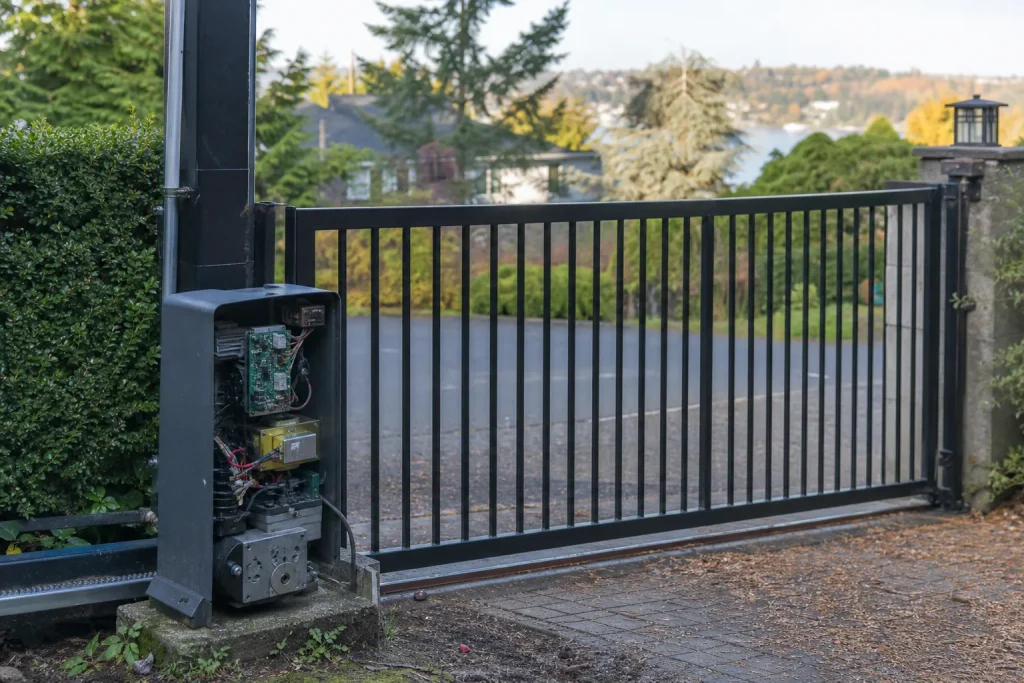
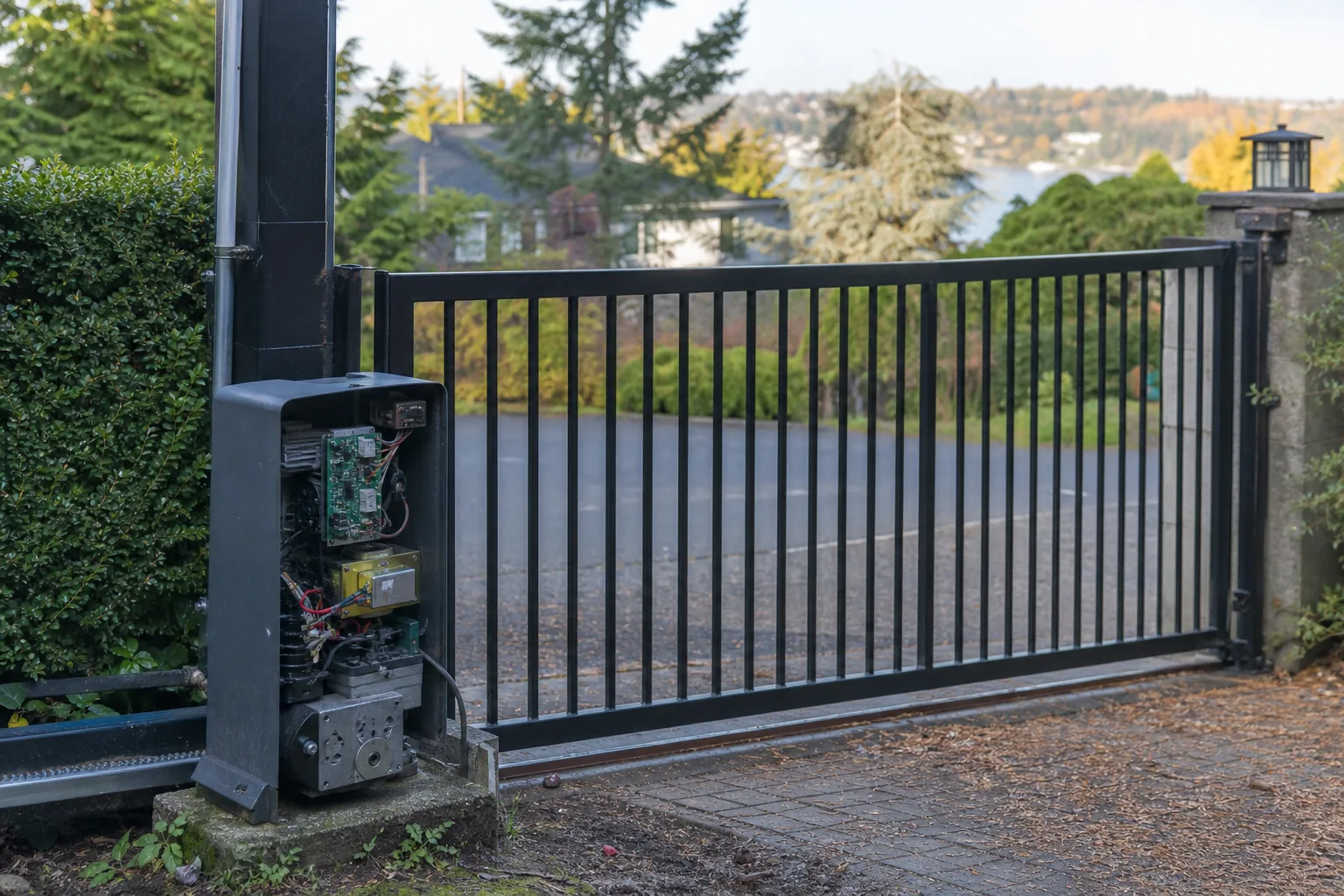
Board corrosion from condensation. DoorKing boards are well-built, but they’re not designed for the temperature cycling of an unheated Seattle equipment room. When outside air at 45°F and 85% humidity hits a board that’s been running warm, condensation forms on the traces. Over three to five years, this produces intermittent failures that look like software problems but are actually physical corrosion. We caught one last month in a Greenwood four-plex where the 1834 board would work fine at 2 PM but fail every morning at 6 AM when the temperature dropped — classic condensation signature.
Keypad seal failure. The rubber membrane on DoorKing 1812 and 1815 entry keypads degrades faster in Seattle’s UV-plus-moisture environment than the manufacturer specs suggest. Water ingress doesn’t always kill the keypad immediately; more often it creates phantom button presses or intermittent responsiveness that frustrates residents and generates repeated service calls. The fix is a genuine DKS keypad with proper sealant, not a generic replacement that’ll fail again in eight months.
Relay burnout from power fluctuations. Seattle City Light’s grid is generally reliable, but the momentary dips during winter windstorms are hard on electromechanical relays. DoorKing boards use relays to trigger gate operators, and after 10+ years of cycling, a voltage sag can weld contacts closed or blow the driver transistor. This is where board-level repair separates from parts-changers: a technician with DKS training can replace the relay or driver, while someone without that expertise will sell you a full board replacement.
How to Identify Your DoorKing Model (And Why It Matters)
Before you call any technician, find your model number. It’s usually on a label inside the main enclosure or on the board itself. Here’s what you’re looking for and what it means for repair versus replacement:
| Model Series | Typical Age | Parts Status | Repair vs. Replace |
|---|---|---|---|
| 1833/1834 | 15–25 years | Limited factory support; some boards refurbished | Repair if board is clean; replace if corrosion is advanced |
| 1835/1838 | 10–18 years | Good parts availability | Usually repairable; software migration possible |
| 1837/1839 | 5–12 years | Full factory support | Repair almost always cost-effective |
| 1812/1815 keypads | 8–20 years | Keypads available; older boards limited | Keypad replaceable; assess board separately |
The model number drives everything: parts availability, programming compatibility, and whether your existing resident access list can migrate to new hardware. We keep a database of Seattle properties we’ve serviced, and when we see a 1833 board in a building we haven’t visited, we bring a refurbished backup board because factory stock is unpredictable. That’s the difference between a same-day fix and a two-week wait for parts.
If you can’t locate your model number, photograph the board and any labels before calling. Any technician worth hiring should be able to identify it from photos and tell you upfront whether they’re carrying parts for that specific generation.
The DoorKing Software Problem Nobody Talks About
Here’s where DoorKing repair gets genuinely specialized. DKS access control isn’t just hardware — it’s a software environment with proprietary programming for resident directories, fob codes, time restrictions, and entry logging. A technician who can swap a board but can’t program it is only solving half your problem.
We’ve inherited jobs in Ballard and Ravenna where the previous “repair” left the new board in factory-default mode, meaning every resident’s fob stopped working and the directory was blank. The property manager then faced two bad options: pay the original technician to come back (if they even had DKS software), or start over with a company that understood the system.
DoorKing’s PC Programmer software and the newer DKS Cloud Manager require specific credentials and hardware interfaces. Not every gate company maintains these. When we evaluate a DoorKing job in Seattle, we ask three software questions before we schedule:
- Is the current resident directory backed up? (Often: no.)
- Are you using fobs, cards, or PINs — and do you have the format specification?
- Does your HOA need entry logging for security review?
These answers determine whether we’re doing a hardware repair with software preservation, or a full system reprogramming. Either is fine — but the price and timeline differ significantly, and you deserve to know that before work starts.
HOA Service Contracts vs. On-Call Repair: What Seattle Property Managers Should Know
Seattle’s condominium and HOA market runs heavy on DoorKing, and we’ve watched the contract versus on-call debate play out across dozens of buildings. Here’s our practical assessment after 14 years in this market.
Service contracts make sense when: your building has 30+ units, the gate sees 200+ cycles daily, and you can’t afford a multi-day outage. A quarterly inspection catches keypad seal degradation, board corrosion early, and relay wear before failure. For buildings in moisture-exposed locations — think anywhere near Puget Sound in West Seattle or the steep, wind-driven rain zones of Queen Anne — that preventive rhythm pays for itself.
On-call repair works when: your system is under 10 years old, your board is a supported model, and your property has backup access control (a secondary pedestrian gate, for instance). The risk is parts lead time on legacy hardware and the software-reprogramming gap we described above.
We offer both models in Seattle, but we’re honest about which fits your actual situation. A 22-year-old 1833 board in a 12-unit Fremont building probably shouldn’t be on a service contract — it’s nearing end-of-life, and the contract fees will exceed replacement cost within two years. We’d rather tell you that upfront than collect payments for false security.
Legacy DoorKing Systems: Repair or Replace?
This is the question we get most from Seattle property managers, and the answer is always specific to the hardware in front of us. But here are the decision rules we’ve developed over 869 jobs:
- Repair if: the board is a 1835 or newer with clean traces, the enclosure has been weatherproofed, and the access list is recoverable. Typical repair: $280–$550, 2–4 hour job.
- Replace if: the board is a 1833 with visible corrosion, the keypad and receiver are mismatched generations, or you’ve already spent 60%+ of replacement cost on failed repairs. Full DKS access control replacement in Seattle: $1,800–$3,500 depending on entry points and fob count.
- Hybrid if: the board is failing but the enclosure and wiring are sound. We can sometimes install a current-generation DKS board that uses existing low-voltage wiring, preserving your infrastructure investment.
We pulled one out of a garage over in Columbia City last month where the previous owner had layered three generations of DKS boards into the same enclosure, none fully removed, with wire nuts connecting incompatible voltage rails. It looked like a fire hazard and functioned like one — intermittent failures for two years before they called us. David diagnosed it himself in twenty minutes: strip to the conduit, fresh board, proper terminal blocks, done. Sometimes the honest assessment is “this has been bandaged too long.”
When to Call a Pro for DoorKing Issues
If your gate is non-responsive, starts and stops erratically, or residents report fob failures that clear up temporarily, you’ve moved past homeowner-level troubleshooting. DoorKing systems involve line-voltage power, low-voltage control circuits, and in some configurations telephone line integration — none of which reward amateur experimentation. The software programming alone requires DKS-specific tools that aren’t available to consumers.
We’re not going to walk you through board-level diagnostics step-by-step because the risk of electrical damage or personal injury outweighs any DIY savings. What we will do is answer your questions honestly when you call, tell you what we’re finding in real time during the repair, and show you the failed component before we replace it. That’s the owner-as-technician difference: David Martinez doesn’t delegate the diagnosis to a junior tech who’ll guess at your expense.
Related services in Seattle: If your property needs more than DoorKing repair, we handle Gate Repair in Tacoma, Gate Installation in Tacoma, and Gate Motor & Opener in Tacoma — full end-to-end capability from the motor to the weld.
The Bottom Line
DoorKing systems are built to last, but Seattle’s climate and the scarcity of genuine DKS expertise create a repair market where partial fixes are common and proper diagnosis is rare. The key takeaways:
- Identify your model before calling — it determines parts availability and repair viability
- Condensation, keypad seals, and relay wear are Seattle-specific failure modes that require local experience
- Software programming is half the job; hardware-only technicians leave you with a blank directory
- Legacy 1833 boards need honest end-of-life assessment, not repeated band-aid repairs
- Service contracts make sense for high-traffic, moisture-exposed properties; on-call works for newer, lower-use systems
If you’re in Seattle and need DoorKing repair that actually fixes the system — not just swaps parts and hopes — Liberty Bell Gate Repair Washington offers free estimates. David Martinez, our owner and lead technician, carries 14 years of gate-specific experience and DKS factory familiarity. Call (855) 275-6878 and we’ll diagnose it honestly, repair it completely, and show you what failed so you understand what you paid for.
Frequently Asked Questions
DoorKing repair in Seattle typically runs $180–$340 for keypad or receiver issues, $280–$650 for board-level repairs, and $450–$1,200 for full access control system failures including software reprogramming. The wide range reflects whether we’re replacing a single component or addressing multiple failure points in legacy hardware. Call (855) 275-6878 for an exact quote — estimates are free.
Some 20-year-old DoorKing systems are worth repairing if the board traces are clean and the enclosure has stayed dry. However, DKS discontinued support for some 1833-series boards, so parts scarcity may make replacement the smarter financial decision within two years. We assess this honestly on every legacy job in Seattle — we’d rather tell you to replace once than repair three times. Call (855) 275-6878 and we’ll evaluate your specific hardware.
The fob receiver is typically a separate board from the entry keypad, so replacing the keypad alone won’t restore fob function. In Seattle’s wet climate, receiver boards often fail from condensation while keypads fail from seal degradation — two different problems requiring two different repairs. A technician with DKS training can diagnose which board is actually failing instead of guessing. Call (855) 275-6878 if your fobs are still dead after a keypad swap.
Yes, for most DoorKing models we can offer same-day service in Seattle because we carry common DKS boards, keypads, and receivers in our service vehicles. Same-day availability depends on model identification — if you can text us a photo of your board label before we dispatch, we’ll confirm we have the right part loaded. Call (855) 275-6878 before noon for best same-day scheduling.
Written by David Martinez, Owner & Lead Technician at Liberty Bell Gate Repair Washington, serving Seattle since 2012.
Need Gate Repair Help?
Call Liberty Bell Gate Repair Washington — licensed & insured, here with fast after-hours help in Washington.
(855) 275-6878