
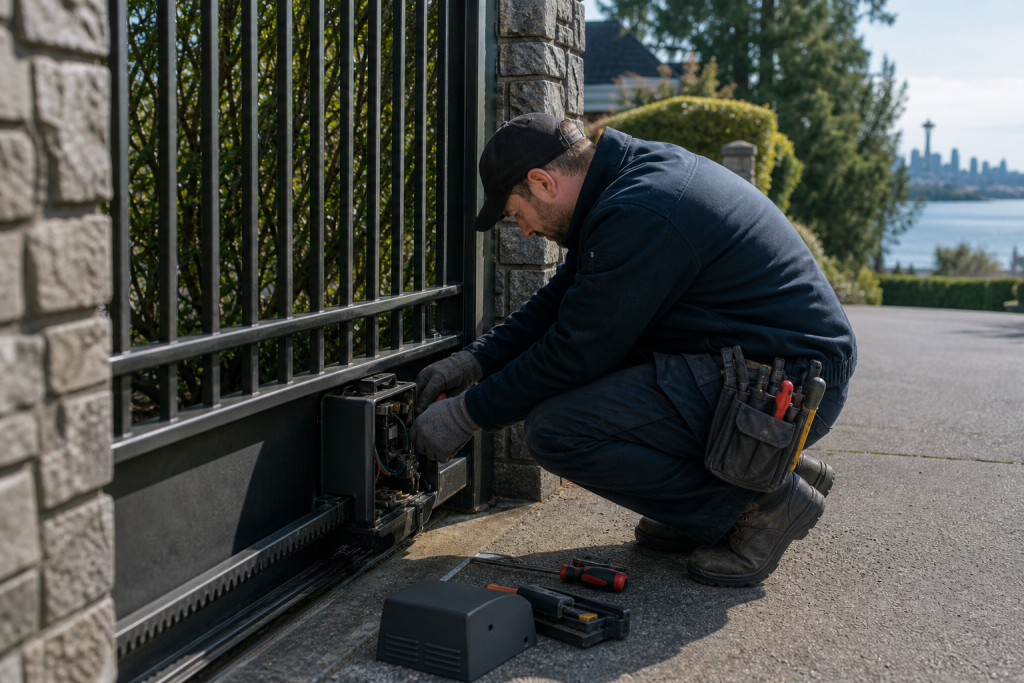
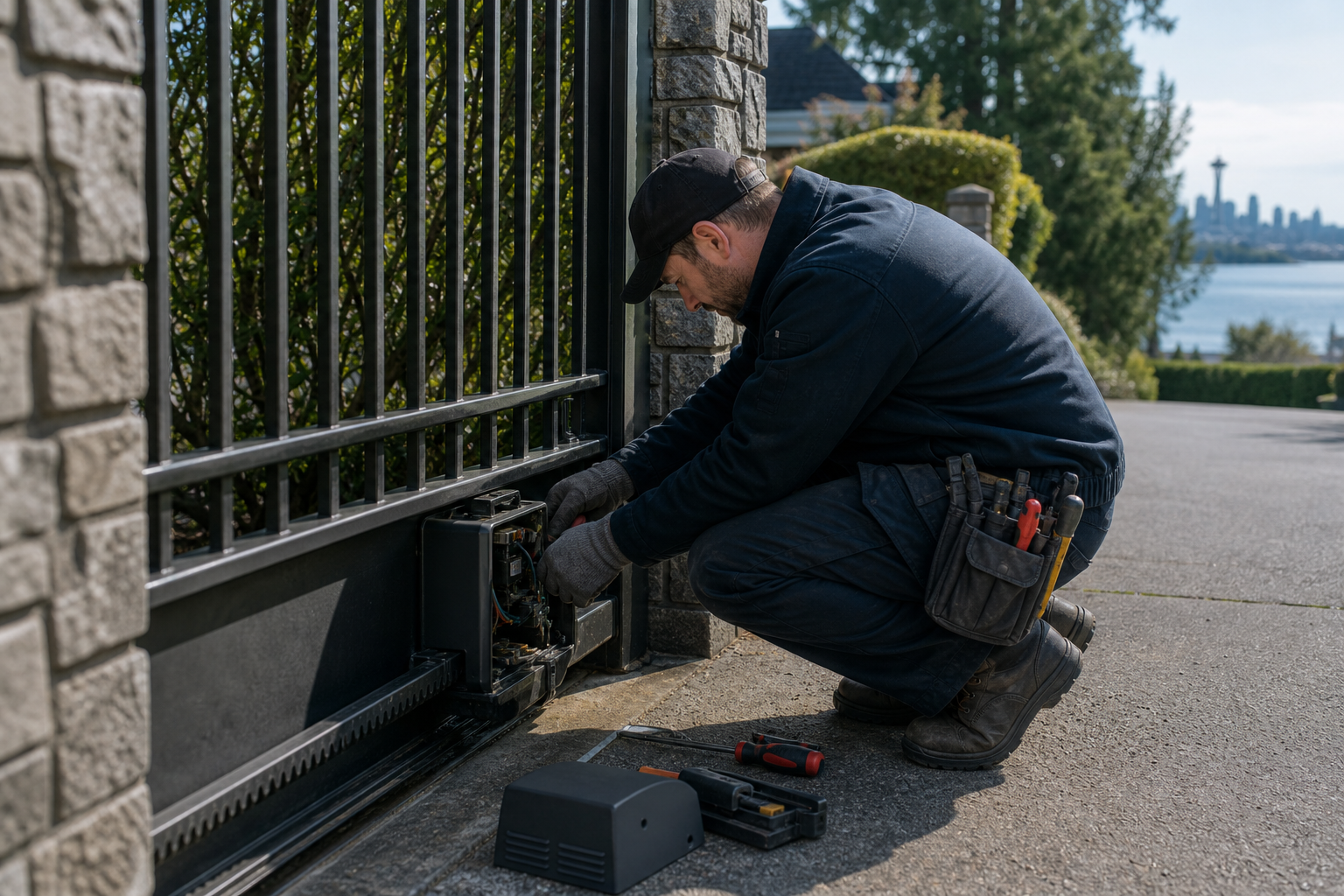
Emergency Gate Repair Near Me: What Seattle Homeowners Should Do First
If your gate fails in Seattle, your first move should be a 90-second safety assessment: check for visible obstructions, determine if anyone or any vehicle is trapped, and locate your gate operator’s manual release mechanism. Most “emergencies” we get called to in Capitol Hill, Ballard, and West Seattle are resolved in under five minutes by the homeowner once they know where that release lever is. If you’d rather not troubleshoot alone, call Liberty Bell Gate Repair Washington home at (855) 275-6878 — we answer until 8pm and offer same-day appointments for genuine emergencies.
Here’s the mistake we see constantly: a homeowner pays a $250 after-hours fee because their gate “won’t close,” when the real problem was a twig caught in the track that cleared with a gloved hand. Or worse — someone forces a stuck gate and bends the rail, turning a $180 adjustment into a $900 welding job. After 14 years and nearly 900 Seattle-area repairs, we’ve learned that what you do in the first five minutes matters more than who you call.
Is This Actually an Emergency? How to Decide Before You Call
Seattle’s damp climate and hilly lots create specific gate failure patterns, but not every failure demands an emergency callout. The distinction costs or saves you hundreds.
True emergency: A gate is physically blocking a vehicle with someone inside, a gate has failed open and created an immediate security breach (elderly resident alone, high-crime block, visible valuables), or a gate has partially collapsed and poses injury risk. These warrant after-hours service.
Urgent but not emergent: Gate won’t open reliably, intermittent sensor failures, slow operation, or stuck open in a secure backyard with no immediate vulnerability. For these, a next-day appointment in Seattle typically runs $80–$150 less than a 10pm dispatch.
Here’s your interim step for a gate stuck open that isn’t a true emergency: secure the opening with temporary measures. Park a vehicle across the driveway if possible, or chain a temporary barrier using materials you already have. Document the gate position with photos for insurance. Then call for a morning appointment. We’ve had Ballard customers tell us this approach saved them $200 in after-hours premiums for a LiftMaster operator reset that took us twelve minutes the next day.
The Seattle blocks where we see the most unnecessary emergency calls? The steep driveways in Queen Anne and Magnolia, where homeowners assume a gate that won’t open on a slope is a motor failure — it’s often just gravity binding the mechanism until the release is engaged.
How to Manually Release Your Gate in Under 90 Seconds
Every automatic gate operator sold in the last two decades has a manual release. Finding it before you’re stressed is the single best preparation you can make. Here’s what to look for by operator type — and yes, we work on all of these brands, so this guidance applies whether you have a LiftMaster, Elite, Mighty Mule, or FAAC system.
Sliding gate operators (most common in Seattle’s level lots):
- Locate the release lever on the motor housing — usually a red or yellow T-handle
- Turn or pull per the direction arrow (typically counterclockwise)
- The gate will now move freely by hand; push from the center to avoid rail binding
- Re-engage by reversing the lever direction once power returns
Swing gate operators (typical for residential driveways):
- Check the motor arm for a small release knob or key slot
- Some LiftMaster models require the key that came with your system
- Release both arms if you have a dual-swing gate — releasing only one strains the remaining motor
- Open slowly; without hydraulic resistance, the gate moves faster than expected
Underground operators (common in upscale Seattle neighborhoods like Medina and Windermere):
- Release is typically a recessed bolt near the ground box
- Requires a standard socket wrench — keep one in your garage
- These systems are heavy; don’t attempt to move alone
Critical safety note: Never force a gate that won’t release. If the lever won’t turn or the gate won’t budge after release, something mechanical is seized — likely a bent track, broken roller, or welded joint failure. Forcing it risks personal injury and converts a repairable component into a full replacement. That’s when you call a professional. David diagnoses these himself — 14 years of reading gate resistance by hand tells us immediately whether we’re looking at a $120 adjustment or a structural weld.
What to Gather Before You Call Any Technician
The most expensive service calls we see in Seattle happen when a technician arrives unprepared. You can prevent this with two minutes of information gathering.
Operator brand and approximate age: The brand name is on the motor housing — LiftMaster, Elite, Mighty Mule, FAAC, or another. If the label’s worn, snap a photo of any visible numbers. Age matters because parts availability varies dramatically; a 2015 FAAC has different internal components than a 2022 model.
Gate material and dimensions: Wrought iron, aluminum, wood, or composite? A 12-foot single swing gate versus a 20-foot dual swing carries completely different motor and hinge loads. Seattle’s moisture means we also need to know if you’re seeing rust at weld points — common on older iron gates in Shoreline and Lake Forest Park.
Symptom description — what it IS doing versus what it’s NOT:
- Motor hums but gate doesn’t move? Likely mechanical binding or stripped gears
- No sound at all? Electrical — remote, keypad, or operator power supply
- Moves partially then reverses? Safety sensor misalignment or obstruction
- Moves slowly or unevenly? Worn rollers, track damage, or motor degradation
When you call Liberty Bell Gate Repair Washington home with this information, David can often diagnose over the phone and arrive with the correct parts. We’ve eliminated second trips for Seattle customers hundreds of times this way. From the motor to the weld, we carry what we need.
Temporary Security: Protecting Your Property While You Wait
A gate stuck open overnight in Seattle doesn’t have to mean sleeping with one eye on the driveway. Here’s what actually works, based on what our customers have done successfully:
Immediate physical barriers: Park your least-used vehicle across the gate opening, or position trash bins, planters, or bicycles to narrow the accessible width. These aren’t foolproof but deter opportunistic entry — the kind most common in residential Seattle.
Lighting and visibility: Motion-activated lights you’ve already installed become more valuable now. If you have smart home integration, trigger indoor lights on a schedule to simulate occupancy. We’ve heard from Fremont and Georgetown customers that this combination held them over for 48-hour parts orders.
Neighbor coordination: In Seattle’s tighter neighborhoods like Wallingford and Green Lake, a quick text to adjacent homeowners creates informal surveillance. Mention you’ll have a repair truck the next morning — this also prevents your actual technician from being questioned.
What doesn’t work: Roping or chaining a gate partially closed without securing to fixed posts. Wind off the Sound or through the Duwamish Valley corridor will shift these arrangements, and a swinging gate damaged by uncontrolled closure costs far more than the original repair. If you can’t secure it properly, leave it fully open and focus on barriers and visibility instead.
When David arrives for the permanent fix, he’ll also assess whether your operator’s auto-close timer was properly configured — many Seattle installations we inherit have this disabled, which turns every minor failure into a security exposure.
Avoiding Emergency Gate Repair Scams in Seattle
The most stressful gate failures — Friday evening, holiday weekend, pouring rain — are when predatory operators thrive. After 14 years in this market, we’ve cleaned up too many of these situations.
Red flag: The “low quote, high invoice” switch. A technician quotes $150 over the phone, arrives quickly, disassembles your operator or gate, then “discovers” additional problems totaling $800–$1,500. By then, your gate is in pieces and you feel trapped. Legitimate specialists provide written estimates before disassembly and explain every finding.
Red flag: No brand specificity. A technician who says “I can fix any gate” but can’t identify your LiftMaster model or explain how Elite safety loops differ from Mighty Mule equivalents is likely a general handyman who watched a YouTube video. Gate operators are not interchangeable; factory familiarity matters for proper diagnosis and parts sourcing.
Red flag: Pressure to replace immediately. “This motor is shot, I have a new one on the truck.” Maybe true — but a 14-year specialist can explain exactly which internal component failed, why repair isn’t viable, and show you the damage. We work on the brand you already have; we don’t profit from unnecessary replacements.
Verify before you authorize: Ask for the technician’s name, how long they’ve been with the company, and whether they’re owner-operated or subcontracted. David Martinez answers these questions himself — he’s the lead technician on every Liberty Bell Gate Repair Washington home job. Nearly 900 neighbors agree: accountability matters.
One we pulled out of a garage over in Ravenna last month: a homeowner had paid a “24-hour gate service” $640 for an “emergency motor replacement” on a FAAC system. The “new motor” was a used unit with the serial number ground off. The actual problem was a $45 limit switch. David found the original motor still functional, just disconnected. We reinstalled it properly, replaced the switch, and the gate outlasted the scammer’s “warranty” period by years.
When to Call a Pro — and What Same-Day Service Actually Looks Like in Seattle
Call a professional when: manual release fails, you hear grinding or clicking from the motor housing, the gate has visible structural damage (sagging, separated welds, bent track), or you’ve eliminated the simple causes and the gate still won’t operate safely.
In Seattle, genuine same-day availability depends on three factors: your location relative to the technician’s current job, parts availability for your specific brand, and whether the issue is diagnostic (requires investigation) or known (you’ve provided enough information to pre-source components). We serve Seattle proper with same-day scheduling for calls received before 2pm; after that, next-morning is typical unless it’s a true emergency.
For related services outside Seattle city limits, we also provide Gate Repair in Tacoma, Gate Installation in Tacoma, and Gate Motor & Opener in Tacoma.
Key Takeaways
- Most Seattle gate “emergencies” are resolved by locating and using the manual release — know your operator type before trouble hits
- Distinguish true emergencies (trapped vehicle, security breach) from urgent repairs to avoid unnecessary after-hours fees
- Gather operator brand, gate material, and specific symptoms before calling — this eliminates return trips and parts delays
- Secure stuck-open gates with physical barriers and lighting, not improvised ropes or partial closures
- Verify technician accountability: owner-operated specialists with brand-specific expertise cost less long-term than fast-cheap operators
The Bottom Line
Seattle’s combination of moisture, hills, and mature landscaping creates specific gate failure patterns that reward prepared homeowners. The five minutes you spend now — locating your manual release, photographing your operator label, saving a trusted specialist’s number — converts future panic into a manageable inconvenience.
14 years, one trade. That’s the difference between a technician who guesses and one who knows. If you’re in Seattle and your gate has you stuck, Liberty Bell Gate Repair Washington home offers free estimates and same-day service when available. Call (855) 275-6878 — David Martinez answers directly when he’s not on a job site.
Frequently Asked Questions
Emergency gate repair in Seattle typically runs $250–$450 for after-hours dispatch, while standard same-day appointments range from $180–$320 depending on the problem’s complexity. A simple operator reset or sensor realignment falls at the lower end; structural welding or motor replacement pushes toward the higher range. Call (855) 275-6878 for an exact quote — estimates are free.
You can safely clear minor obstructions, use the manual release, and check for visible sensor misalignment yourself. Never attempt electrical diagnosis, spring or tension cable adjustment, or structural welding — these carry genuine injury risk and can void your operator warranty. If the manual release doesn’t free the gate, or if you hear abnormal motor noise, it’s time to call a professional. We’ve seen DIY attempts in Seattle turn $200 adjustments into $1,000 replacements.
Seattle’s persistent moisture causes three common failures: moisture intrusion in underground conduit corrodes low-voltage connections, wood gate frames swell and bind against posts or latches, and safety sensors misread when condensation forms on lenses. We address these with sealed connections, seasonal adjustment protocols, and sensor relocation when needed — all part of standard service calls in our market.
A motor needs replacement when internal gears are stripped (audible grinding with no movement), the housing is cracked allowing water intrusion, or repair parts are discontinued for your model age. It’s repairable when the issue is external: capacitor failure, limit switch problems, or control board issues. David evaluates this in person — we work on the brand you already have and don’t profit from selling you a new unit you don’t need. Call (855) 275-6878 to schedule an assessment.
Written by David Martinez, Owner & Lead Technician at Liberty Bell Gate Repair Washington, serving Seattle since 2012.
Need Gate Repair Help?
Call Liberty Bell Gate Repair Washington — licensed & insured, here with fast after-hours help in Washington.
(855) 275-6878