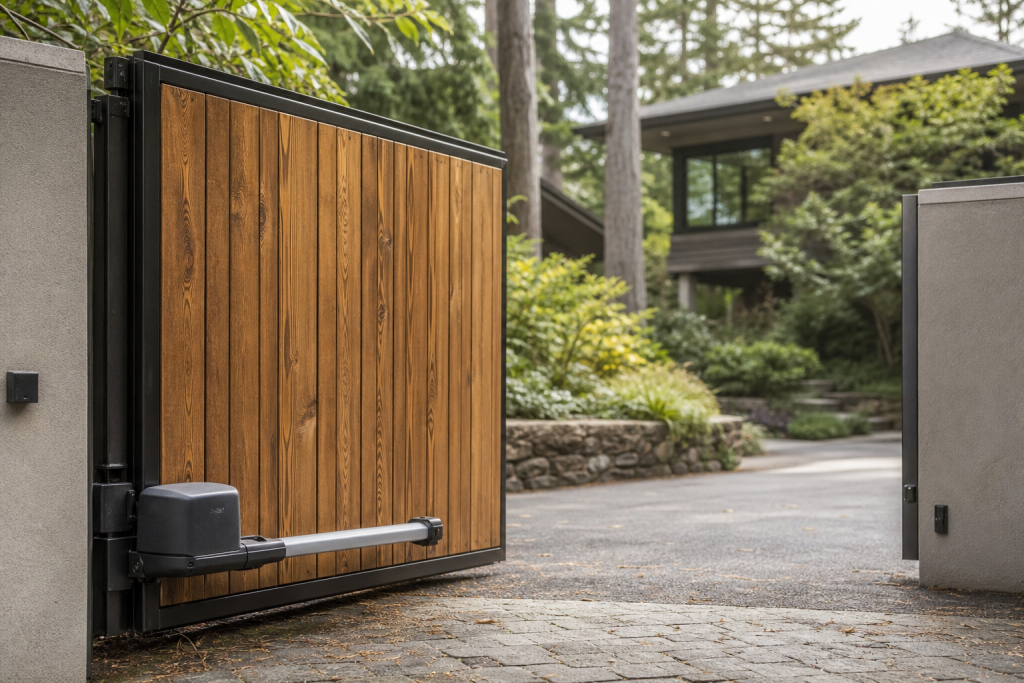
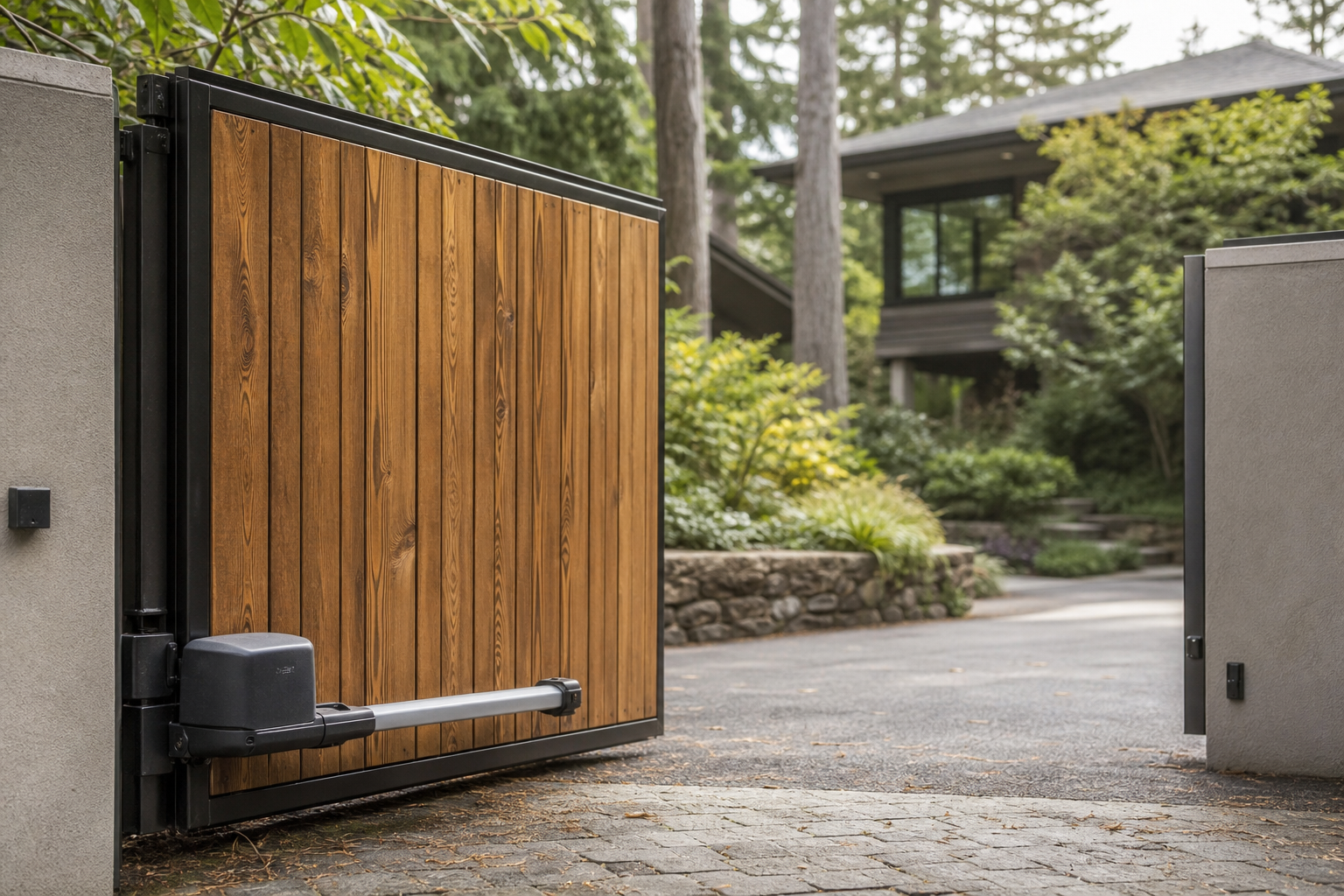
Ghost Controls Gate Repair in Seattle: A Homeowner’s Guide
Ghost Controls gate repair in Seattle typically runs $180–$420 depending on whether the issue is electrical, mechanical, or installation-related, and most problems can be diagnosed same-day. The catch? Many failures we see aren’t actually manufacturing defects—they’re the result of a system designed for sunnier climates struggling through six months of Pacific Northwest gray. If you’d rather not troubleshoot this yourself, call us at (855) 275-6878 for a free estimate.
Here’s something the box at Home Depot won’t tell you: Ghost Controls solar gate openers are rated for charging efficiency based on 5–6 peak sun hours per day. Seattle averages 2.4 from October through March. That gap isn’t a footnote—it’s why we get calls from Ballard to Beacon Hill every winter from homeowners whose gates have gone completely dead. The system isn’t broken; it’s starving.
Why Seattle’s Climate Breaks the Ghost Controls Solar Promise
We’ve been repairing gates in Seattle for 14 years, and Ghost Controls systems follow a predictable seasonal pattern. The solar panel that keeps the battery topped off in Arizona simply can’t harvest enough energy here during our long, cloudy winters. The battery cycles deeper, stays discharged longer, and degrades faster than the manufacturer expects.
The symptoms show up in stages:
- September–October: Gate slows slightly on cold mornings, but still opens
- November–January: Intermittent non-response, especially after consecutive overcast days
- February–March: Complete failure to open, or the motor runs but lacks torque to move the gate
We pulled a system out of a garage in Wedgwood last February where the homeowner had replaced the battery twice in 18 months, convinced he had a lemon. The batteries were fine. The solar panel was fine. The math was just wrong for Seattle’s latitude and cloud cover.
The practical fix isn’t complicated, but it does require admitting the solar-only approach won’t work here year-round. We typically recommend one of two paths: adding a hardwired AC transformer as primary power with solar as backup, or upgrading to a larger 30-watt panel array instead of the stock 10-watt. Either solution costs $200–$350 in parts and labor, and it ends the seasonal death cycle.
The Three Failure Modes We See Most on Ghost Controls in Seattle
After 869 service calls, we’ve narrowed Ghost Controls failures in this climate to three recurring patterns. Knowing which one you’re dealing with saves time and money.
Battery failure from chronic undercharging. This is number one by a wide margin. The sealed lead-acid batteries Ghost Controls ships with are rated for 300–500 deep cycles. In Seattle’s winter, they hit that limit in 18–24 months instead of the 4–5 years the manual suggests. The battery tests “okay” on a multimeter but collapses under load. We always load-test, not just voltage-test, because a sitting battery can show 12.6 volts and still fail to crank the motor.
Limit switch drift from moisture intrusion. Ghost Controls uses magnetic limit switches that are sensitive to condensation. Seattle’s humidity, combined with temperature swings between night and day, causes micro-corrosion on the switch contacts. The gate starts “hunting”—opening 6 inches past its stop, then reversing, or closing with a hard bang. The fix is cleaning the contacts and, in persistent cases, relocating the switch housing to a drier position or adding a desiccant pack.
Arm connector wear from salt air and grit. For homeowners near Puget Sound or any of Seattle’s saltwater-facing neighborhoods—Magnolia, West Seattle, parts of Shoreline—the aluminum arm connectors oxidize faster than inland installs. The symptom is a grinding noise or visible play in the arm where it meets the gate bracket. Left alone, the wear transfers stress to the motor mount and cracks the housing. We caught one in Alki that was two weeks from a $680 motor replacement; a $45 connector and 20 minutes of preventive work fixed it.
Warranty Problem vs. Installation Problem: How to Tell
This distinction matters because it determines whether you’re calling Ghost Controls support, the original installer, or a repair specialist like us.
Likely a warranty/parts issue: The system worked correctly for 6+ months, then failed with no environmental changes. Motor makes a consistent humming but doesn’t engage. Remote responds but actuator doesn’t move. These point to internal component failure—solenoid, circuit board, or gear train—and Ghost Controls’ 3-year warranty typically covers them.
Likely an installation issue: The system never worked quite right, or problems started within the first season. Gate stalls in wet weather. Solar panel was mounted facing east (we’ve seen it) or under tree cover. Post spacing is at the outer limit of tolerance, causing binding. Battery dies every winter like clockwork. These aren’t defects; they’re mismatches between the install and Seattle’s conditions.
Here’s where it gets frustrating: Ghost Controls’ phone support is based in Texas and calibrated for Sunbelt installations. When you describe your battery dying in December, their troubleshooting script starts with “check for obstructions on the solar panel”—as if 40 days of consecutive cloud cover is an obstruction you can clear. We’ve learned to ask specific questions that bypass the script: “What’s the minimum wattage you’d recommend for a 47-degree-north latitude install with 2.4 average sun hours?” That gets you to a technical supervisor who can actually help.
When to Repair Your Ghost Controls System—and When to Replace It
We’re not in the business of selling people gates they don’t need. “We work on the brand you already have” isn’t just a slogan; it’s how we’ve stayed in business 14 years in one trade. But there are honest breakpoints where replacement makes more sense than another repair.
Repair it if: The system is under 5 years old, the failure is isolated (one component, not systemic), and you’re willing to address the power supply issue. A $200 battery and charging upgrade plus a $180 limit switch repair on a 3-year-old system is sensible math.
Consider replacing if: The system is over 7 years old, you’ve already replaced the battery twice, and you’re looking at motor or control board failure. At that point, you’ve likely spent $600+ in cumulative repairs and still have a system fundamentally underpowered for Seattle’s climate. Brands like LiftMaster and DoorKing offer low-voltage AC options with battery backup that don’t pretend solar is the primary power source. Elite and Mighty Mule also have models we install regularly for Seattle homeowners who want reliability over DIY appeal.
From the motor to the weld, we can repair what you have or install what you actually need. David diagnoses it himself—14 years, one trade, and nearly 900 neighbors agree the assessment is worth hearing before you spend money.
When to Call a Pro
If your gate is stuck open, stuck closed, or behaving unpredictably, that’s a security issue, not a weekend project. Ghost Controls systems run on 12V DC, which won’t electrocute you, but a 400-pound gate that moves unexpectedly can crush a hand or pin a child. We offer same-day response in Seattle for inoperable gates, and we’ll tell you honestly whether the fix is $45 or it’s time to talk replacement.
Related services in Seattle: Liberty Bell Gate Repair Washington home, Gate Repair in Tacoma, Gate Installation in Tacoma, Gate Motor & Opener in Tacoma.
Key Takeaways
- Ghost Controls solar ratings assume 5–6 sun hours daily; Seattle gets 2.4 in winter—expect battery failure without hardwired backup or larger panels
- The three top failure modes here: battery death from undercharging, limit switch drift from moisture, arm connector corrosion from salt air
- Support scripts are written for sunny climates; ask technical questions about latitude and sun hours to get useful answers
- Repair makes sense for isolated failures on newer systems; replacement is smarter for older units with cumulative problems
- Any inoperable gate is a security risk—professional diagnosis protects safety and prevents throwing parts at the wrong problem
The Bottom Line
Ghost Controls makes a decent opener for the right climate. Seattle isn’t that climate—not without modification. The good news is that most “broken” Ghost Controls systems we see in Seattle aren’t actually broken; they’re underfed and misdiagnosed. A proper power supply fix, moisture management, and occasional preventive maintenance can extend the system’s life by years.
If you’re in Seattle and tired of seasonal gate failure, Liberty Bell Gate Repair Washington offers free estimates with no dispatch fee—call (855) 275-6878. David Martinez will diagnose it himself, tell you exactly what’s wrong, and fix only what needs fixing. Fourteen years, one trade, from the motor to the weld.
Frequently Asked Questions
Most Ghost Controls repairs in Seattle run $180–$420. A simple battery and charging upgrade is typically $200–$350, limit switch cleaning or replacement is $150–$280, and arm connector work runs $120–$200. Motor or control board replacement pushes closer to $500–$680. Call (855) 275-6878 for an exact quote—estimates are free.
Yes, for inoperable gates we offer same-day response throughout Seattle. If the gate is stuck open or closed, that’s treated as a priority for security reasons. Standard non-urgent repairs are typically scheduled within 24–48 hours. Call (855) 275-6878 to check current availability.
For systems under 5 years old with a single failure, repair is almost always cheaper. For systems over 7 years old that have needed multiple repairs, replacement often saves money within two years. We work on the brand you already have and won’t push replacement unless the math genuinely favors it. Call (855) 275-6878 for an honest assessment.
Because the solar panel can’t harvest enough energy during Seattle’s short, cloudy winter days to maintain the battery. The battery gradually discharges deeper each cycle until it fails permanently. Adding a hardwired AC transformer or upgrading to a larger solar array solves this permanently. We see this pattern so predictably that we now ask “which month does it usually fail?” and the answer is almost always January or February.
Written by David Martinez, Owner & Lead Technician at Liberty Bell Gate Repair Washington, serving Seattle since 2012.
Need Gate Repair Help?
Call Liberty Bell Gate Repair Washington — licensed & insured, here with fast after-hours help in Washington.
(855) 275-6878