How an Automatic Gate Opener Works: A Five-Part Loop That Keeps Your Washington Property Secure
An automatic gate opener is a closed-loop system of five interdependent components: a trigger (remote, keypad, or sensor), a control board that interprets the signal, a power unit that drives the motor, a mechanical drive that physically moves the gate, and safety feedback sensors that tell the control board when to stop or reverse. When any one of these five breaks the loop, the entire system fails — which is why understanding the sequence helps you describe symptoms accurately and avoid paying for parts you don’t need. If your gate is acting up in Washington, call us at (855) 275-6878 and we’ll walk through the loop together over the phone before we ever dispatch.
We’ve spent 14 years tracing failures through this exact sequence across every neighborhood from Capitol Hill to Chevy Chase, through humid summers that corrode circuit boards and freeze-thaw winters that seize rack-and-pinion drives. The gates we work on aren’t theoretical — they’re the ones that won’t open at 6:47 a.m. when you’re already late for the Metro, or that start closing on your bumper because a limit switch drifted out of calibration. David Martinez, our owner and lead technician, grew up in Takoma watching this city’s older properties get patched back together, and he’s been the one doing the patching for the past decade and a half. Here’s how the system actually works, the way he’d explain it standing in your driveway.
The Five-Component Loop: Why Your Gate Fails Where It Does
Most explainers treat gate opener components like separate chapters in a manual. We don’t — because in 14 years of repairs, we’ve never seen a failure that didn’t involve how two or more parts talk to each other. The loop matters.
Here’s the sequence, and more importantly, what breaks at each stage:
- Trigger: Remote, keypad, vehicle sensor, or intercom sends a signal. Common failure: dead remote battery, misaligned vehicle loop detector, or keypad corrosion from Washington’s spring humidity.
- Control board: The brain that validates the signal and decides direction, speed, and force. Common failure: surge damage from summer thunderstorms, or capacitor degradation after 8-12 years.
- Power unit / motor: Converts electrical energy to mechanical torque. Common failure: thermal overload from repeated obstruction cycling, or bearing wear in older LiftMaster and DoorKing units.
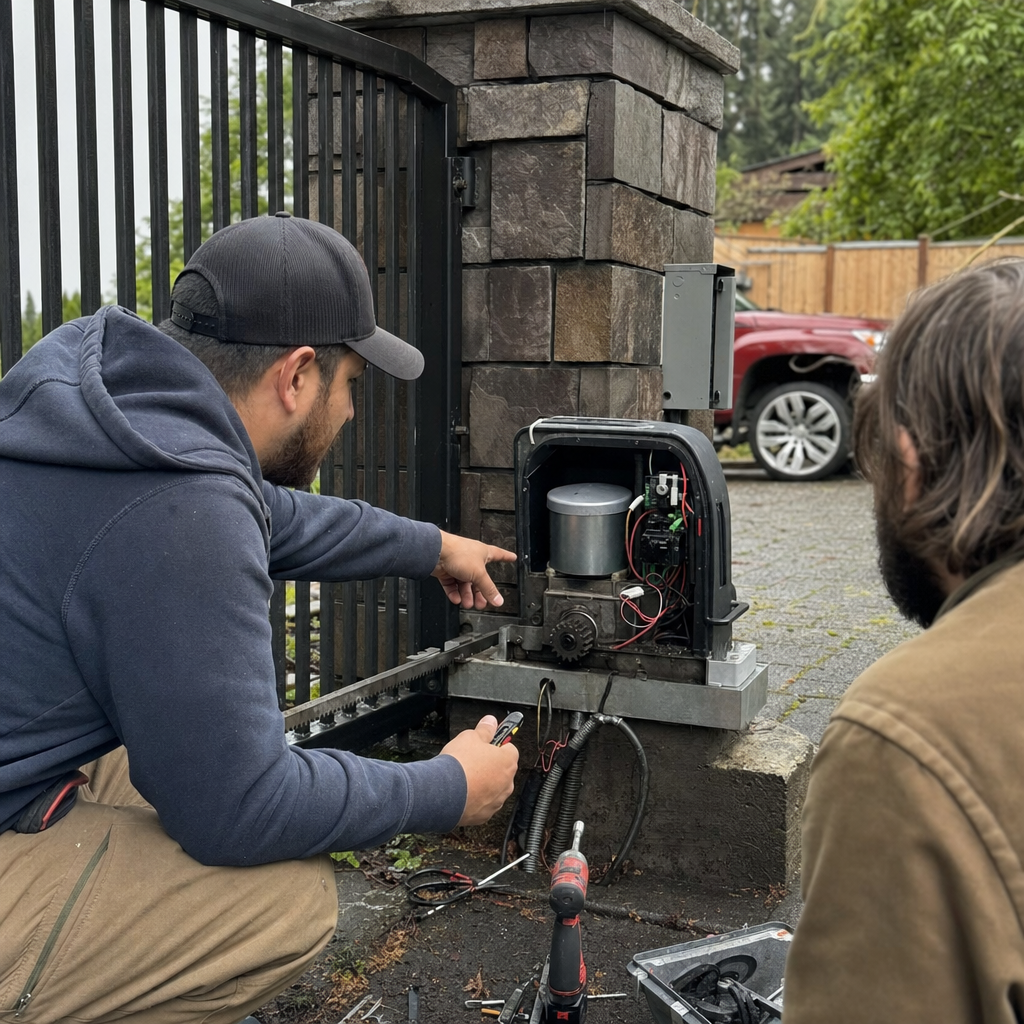
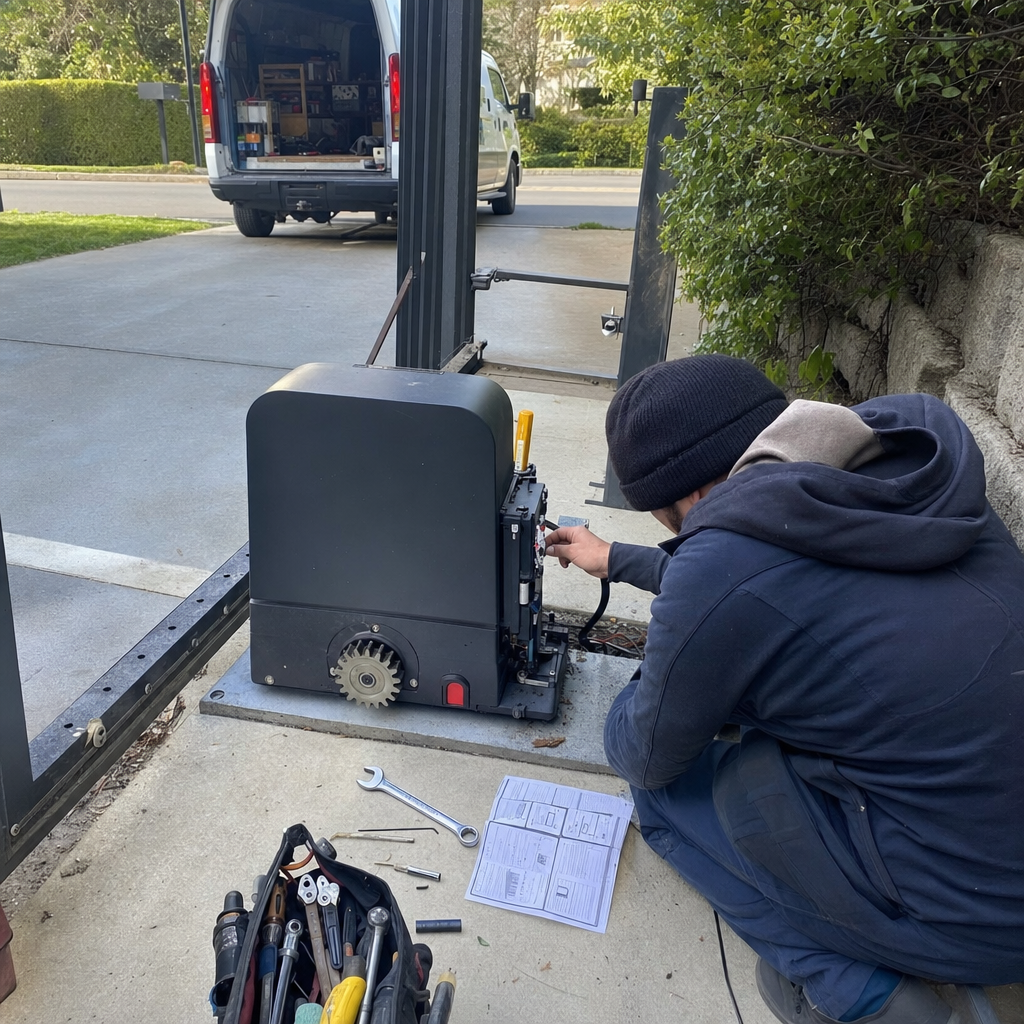
- Mechanical drive: Linear actuator, rack-and-pinion, chain, belt, or underground arm — the physical linkage that moves the gate. Common failure: seized actuator from water intrusion, stretched chain on heavy slide gates, or stripped nylon gear in Mighty Mule residential openers.
- Safety feedback: Limit switches, photocells, and edge sensors report position and obstacles back to the control board. Common failure: limit switch drift (the gate that “works sometimes”), photocell misalignment from frost heave, or edge sensor cable damage from landscaping equipment.
The critical insight: symptoms point to loop position. “It does nothing at all” usually means power or control board — upstream in the loop. “It starts moving then reverses after two feet” almost always means safety feedback — downstream, where the control board thinks it’s hitting an obstacle. When you can describe the symptom in loop terms, we can narrow the diagnosis before we even pull into your driveway.
This systems-thinking approach is why we don’t show up with a truck full of parts and hope something fits. David diagnoses it himself, and he’s factory-familiar with how each brand implements the loop differently. A DoorKing 9100 handles limit switch logic through optical encoders; an Elite CSW200 uses mechanical switches with manual calibration screws. Same loop, different language — and 14 years of one trade means we read the dialect fast.
Limit Switches: The Component You’ve Never Heard Of That Causes the Most Confusion
If there’s one part that makes homeowners think they’re going crazy, it’s the limit switch.
Here’s the plain explanation: your gate has no eyes. It doesn’t know where “open” or “closed” is unless something tells it. The limit switch is that something — a physical or optical sensor that marks the travel endpoints. When it drifts, your gate might stop six inches short of the latch one day, ram the stop post the next, or reverse direction mid-travel for no apparent reason.
The maddening part? It often intermittently works. You’ll test it ten times successfully, then it fails on the eleventh when you’re rushing to catch a flight out of Reagan National. That’s because limit switches are sensitive to temperature expansion, vibration loosening, and — in Washington specifically — the clay-heavy soils of neighborhoods like Petworth and Brookland that shift with moisture and throw gate alignment off by fractions of an inch.
We’ve replaced limit switches that were “fine” according to multimeter testing but failed under thermal load. We’ve also seen $800 motor replacements quoted when a $45 switch and 20 minutes of calibration was the actual fix. Understanding this component protects your wallet.
The adjustment procedure varies by brand: LiftMaster residential openers typically use a digital menu; FAAC and BFT commercial systems require physical limit cams; older Elite models need a screwdriver and patience. We work on the brand you already have — no “we only service our own equipment” limitations.
Drive Mechanisms: Why Your Neighbor’s Fix Doesn’t Apply to Your Gate
Not all automatic gate openers move gates the same way, and this matters for both diagnosis and repair cost.
| Drive Type | Gate Style | Typical Washington Application | Common Failure Mode | Repair Range |
|---|---|---|---|---|
| Linear actuator (arm) | Swing gate | Residential driveways, Capitol Hill row houses | Seized ram from water intrusion, worn bushings | $280–$520 |
| Underground actuator (submerged motor) | Swing gate | Historic districts, high-end installations where hardware must be hidden | Flooded motor housing, stripped reduction gears | $680–$1,400 |
| Rack-and-pinion | Slide gate | Commercial properties, narrow residential lots in Takoma or Shepherd Park | Debris in rack, stripped pinion from binding | $340–$780 |
| Chain or belt drive | Slide gate | Heavy commercial gates, industrial zones near New York Avenue | Stretched chain, broken master link, worn sprockets | $260–$640 |
The rack-and-pinion systems we see most in Washington’s tighter residential lots are particularly sensitive to track alignment. A quarter-inch of frost heave — common after the kind of hard freeze we get every third winter — and the pinion starts skipping teeth. The motor keeps running, the control board thinks the gate is moving, but nothing happens. That’s a mechanical drive failure masquerading as a motor problem.
From the motor to the weld, we handle the full chain. Our Gate Motor & Opener service covers diagnostics through replacement, and when the issue is structural — bent track, cracked weldment, sagging gate frame — we don’t subcontract out to a separate welding crew. David does that work himself.
Brand Fluency: Same Loop, Different Dialects
The five-component loop is universal, but every brand implements it with its own quirks. This matters when you’re choosing between a repair tech who knows one system and one who reads nine.
LiftMaster’s MyQ-enabled boards, for instance, integrate smartphone control through a proprietary RF protocol that can interfere with older keypad frequencies if not properly configured. FAAC’s 740 and 844 series use a hydraulic bypass system for obstacle detection that’s entirely different from the electronic current-sensing approach in a Viking G-5. DoorKing’s 9150 and 9210 operators have a diagnostic LED sequence that tells experienced techs exactly which feedback sensor is throwing the error — if you know to look for it.
We’ve been certified across these systems for years. When a homeowner tells us “it’s a Mighty Mule and the remote works but the keypad doesn’t,” we already know to check the dip-switch addressing before we leave the shop. That saves you a trip charge and a second appointment.
Our home page has more on our full service range, but for opener-specific work, our Gate Motor & Opener in Washington page covers installation, replacement, and upgrade options.
What Washington’s Climate Does to Gate Openers (That Manuals Written in California Don’t Mention)
Generic explainers never account for place. We do, because place breaks things.
Washington’s humidity is the silent killer of control boards. Not dramatic flooding — just the slow, seasonal moisture cycling that corrodes terminal blocks and degrades capacitors. We’ve opened outdoor-rated enclosures in Chevy Chase and found green copper oxide on every connection, the board technically “working” but voltage-dropping enough to cause intermittent failures.
The freeze-thaw cycle is harder on mechanical drives. Water seeps into actuator housings during fall rains, freezes in January, cracks seals, and introduces contamination that destroys ram surfaces by March. We see this pattern every year, predictable as the cherry blossoms.
And then there’s the power quality. Washington’s older neighborhoods — Takoma, parts of Georgetown, the pre-war stock in Mount Pleasant — still have branch circuits that sag under motor startup load. A gate opener that tests fine on a bench fails in place because the available amperage at the end of a 80-foot underground run isn’t what the spec sheet assumes. We measure this. We don’t guess.
David’s local roots matter here. Growing up in Takoma, watching how this city’s infrastructure actually performs versus how it’s supposed to perform — that’s not training you get from a factory seminar. It’s the difference between a tech who replaces parts and one who solves problems.
When to Call: Symptoms That Mean Professional Diagnosis
We’re not going to pretend every gate problem needs a service call. Replace your remote battery. Clear debris from the track. Check that photocell alignment — the LED indicators usually tell you if they’re talking to each other.
But call us when:
- The gate reverses unpredictably mid-travel — this is a safety system override, and overriding the override yourself risks entrapment liability
- You hear the motor running but the gate doesn’t move — mechanical drive failure, and continuing to cycle it will destroy the motor
- There’s any sparking, burning smell, or erratic control board behavior — electrical faults in outdoor enclosures can escalate quickly
- The gate “works fine” except on hot afternoons or cold mornings — thermal or limit drift, both of which worsen until they don’t work at all
High-tension springs on some swing gate assist systems can cause serious injury if released improperly. We don’t recommend DIY adjustment of mechanical assist components — the stored energy is substantial, and we’ve seen the aftermath.
If I wouldn’t trust the fix on my own property, I’m not leaving it on yours.
FAQs
Most automatic gate opener repairs in Washington range from $180 for simple limit switch or sensor adjustments to $780 for drive mechanism rebuilds, with full motor/control board replacements running $680–$1,400 depending on brand and horsepower. Underground actuator systems and commercial-grade operators trend higher due to excavation or heavy-duty component costs. Call (855) 275-6878 for an exact quote — estimates are free, and we’ll diagnose over the phone when possible.
Your gate reverses because the safety feedback loop is telling the control board there’s an obstacle, even when there isn’t — usually a misaligned photocell, a drifting limit switch, or debris triggering the edge sensor. In Washington’s freeze-thaw climate, track shift and sensor mount loosening are common culprits we see every winter. This symptom is actually valuable: it tells us the motor and control board are functional, narrowing diagnosis to the feedback path.
We offer same-day service for most automatic gate opener repairs in Washington when you call before noon, and we stock common limit switches, sensors, and drive components for LiftMaster, DoorKing, Elite, and Mighty Mule systems. Emergency after-hours service is available for security-critical failures — properties where a non-functioning gate leaves the driveway exposed overnight. Call (855) 275-6878 and we’ll give you a realistic arrival window.
Repair is usually the better value if your opener is under 12 years old, the failure is isolated to one loop component (trigger, sensor, or drive), and the brand is still supported for parts — we can source components for all nine brands we service. Replacement makes more sense when the control board is obsolete, multiple failures are cascading, or you’re upgrading from a basic remote system to integrated access control with smartphone management. We’ll tell you honestly which path saves money over a 5-year horizon — 14 years, one trade, and nearly 900 neighbors agree we don’t upsell replacement when repair is the right call.
Key Takeaways
- An automatic gate opener is five interdependent components in a loop, not standalone parts — understanding the loop helps you describe symptoms and evaluate quotes
- Limit switches are the most misunderstood component and the source of “intermittent” failures that drive homeowners crazy
- Drive mechanism type (actuator, rack-and-pinion, chain/belt) determines both failure modes and repair costs — your neighbor’s swing gate fix doesn’t apply to your slide gate
- Washington’s humidity, freeze-thaw cycles, and older electrical infrastructure create failure patterns that generic explainers miss
- Brand-specific fluency matters: same loop, different implementation, and a tech who reads nine brands diagnoses faster than one who learned on a single system
If you’d rather have it looked at, Liberty Bell Gate Repair Washington offers a no-pressure assessment in Washington — call (855) 275-6878. David Martinez handles the diagnosis himself, and if we can solve it over the phone, we’ll tell you that too.
Written by David Martinez, Owner & Lead Technician at Liberty Bell Gate Repair Washington, serving Washington, WA.