Why Is My Gate Motor Not Working? The Real Diagnostic Order Most Technicians Skip
A gate motor that won’t run usually isn’t a failed motor at all — it’s most often a power supply issue, a fried control board, or a stuck limit switch preventing the system from completing its safety check. In 14 years of diagnosing gates across Washington, David Martinez has found the motor itself is the actual culprit in fewer than one in five “dead motor” calls. Here’s the diagnostic hierarchy that saves homeowners from unnecessary $800–$1,400 gate motor replacement costs in Washington, WA.
Call (855) 275-6878 if you’d rather skip the troubleshooting and get David’s eyes on it directly — estimates are free, and same-day service is available throughout Washington.
Washington’s Climate Is Harder on Gate Electronics Than on Motors
The humidity spikes we get along the Potomac, especially in late summer when the air feels like a wet blanket, corrode circuit board traces and fry transformers long before they threaten a motor’s windings. We’ve opened control boxes in Chevy Chase and Takoma Park where the board looked like it spent a month underwater — green oxidation across every terminal — while the motor beneath it sat pristine in its sealed housing.
Winter’s freeze-thaw cycles do their own damage. Water finds its way into conduit, expands, cracks junction boxes, and creates intermittent shorts that make a gate motor appear completely dead one morning and perfectly fine the next. That inconsistency is actually a diagnostic clue: a truly failed motor stays failed. An electrical gremlin comes and goes with temperature and moisture.
Washington’s older housing stock — the brick colonials in Shepherd Park, the mid-century ramblers in American University Park — often has original 120V outdoor outlets that weren’t designed for modern gate loads. Voltage drop under start-up current is invisible until you put a meter on it, but it’ll make a healthy motor hum and stall every single time.
The Diagnostic Hierarchy: Start Upstream, Work Down
Think of it like a light that won’t turn on. You don’t replace the bulb before checking if the switch is flipped or the breaker tripped. Yet that’s exactly what happens when a technician declares “bad motor” without testing what feeds and controls it first.
Here’s the order David Martinez follows on every call, and what each step reveals:
- Power supply — Is the outlet live? Is voltage stable under load? We see 15–20% voltage drop on older Washington circuits that kills motor start torque without ever tripping a breaker.
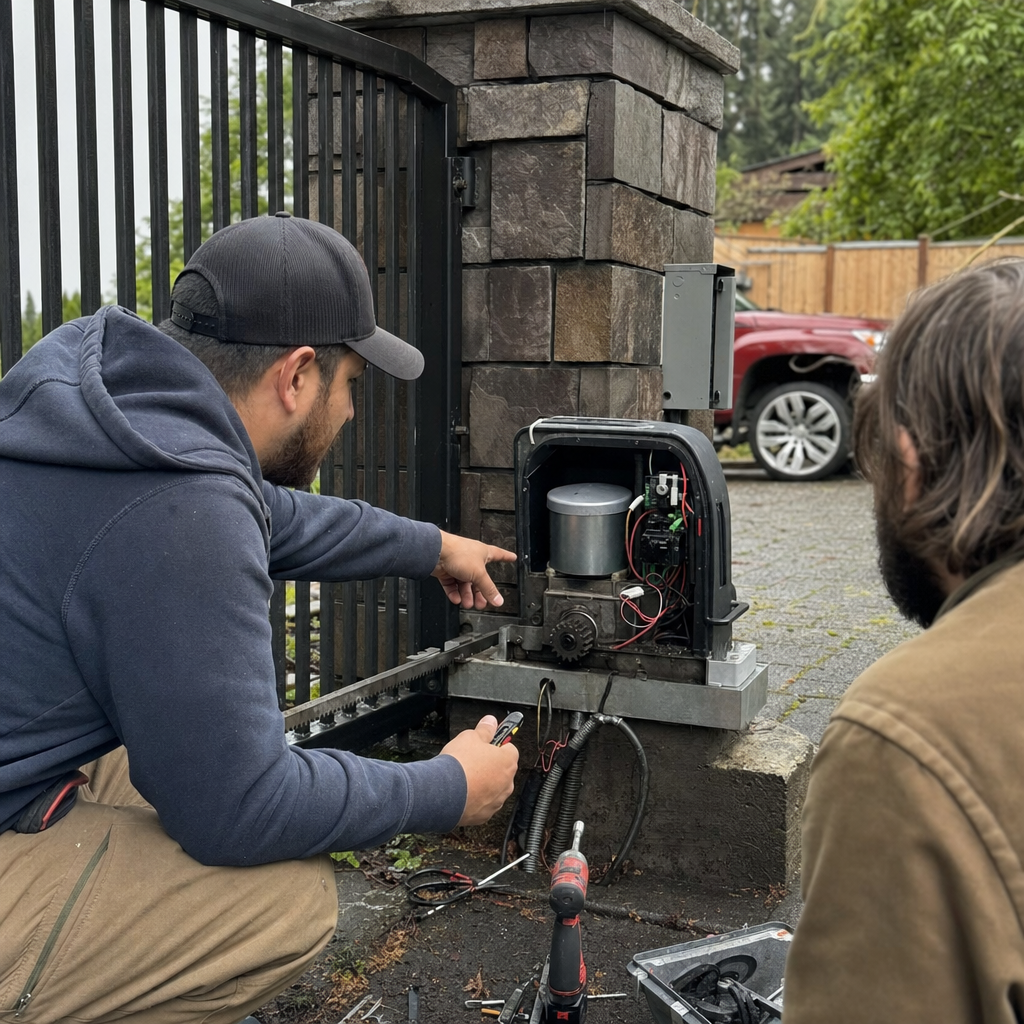
- Control board / logic module — This is where 40–50% of “dead motor” problems actually live. The board receives the signal, processes safety inputs, and tells the motor when to run. No board output = no motor movement, even with perfect power.
- Limit switches and safety sensors — A misaligned photo eye or stuck limit switch tells the system “don’t move, something’s wrong.” The motor isn’t broken — it’s being overridden by safety logic.
- Start capacitor — The underdiagnosed middle ground. A $15–$40 part that provides the initial torque burst. When it fails, the motor hums or does nothing. David encounters this regularly on systems 5–8 years old, and it’s almost never the first thing other techs check.
- The motor itself — Windings, bearings, gear wear. Genuine motor failure, when you reach this point with confidence, is straightforward to confirm with amp draw and resistance tests.
Skipping this sequence is how a $200 electrical repair becomes a $1,200 motor swap. We’ve cleaned up after “replacement specialists” who never owned a multimeter.
Capacitor Failure: The $30 Problem That Looks Like a $1,000 Problem
This deserves its own section because it’s so consistently missed. A start capacitor stores the electrical kick a single-phase motor needs to overcome inertia and begin turning. When it degrades — and they do, predictably, after 5–8 years in Washington’s humidity — the motor either hums loudly without moving or appears completely unresponsive.
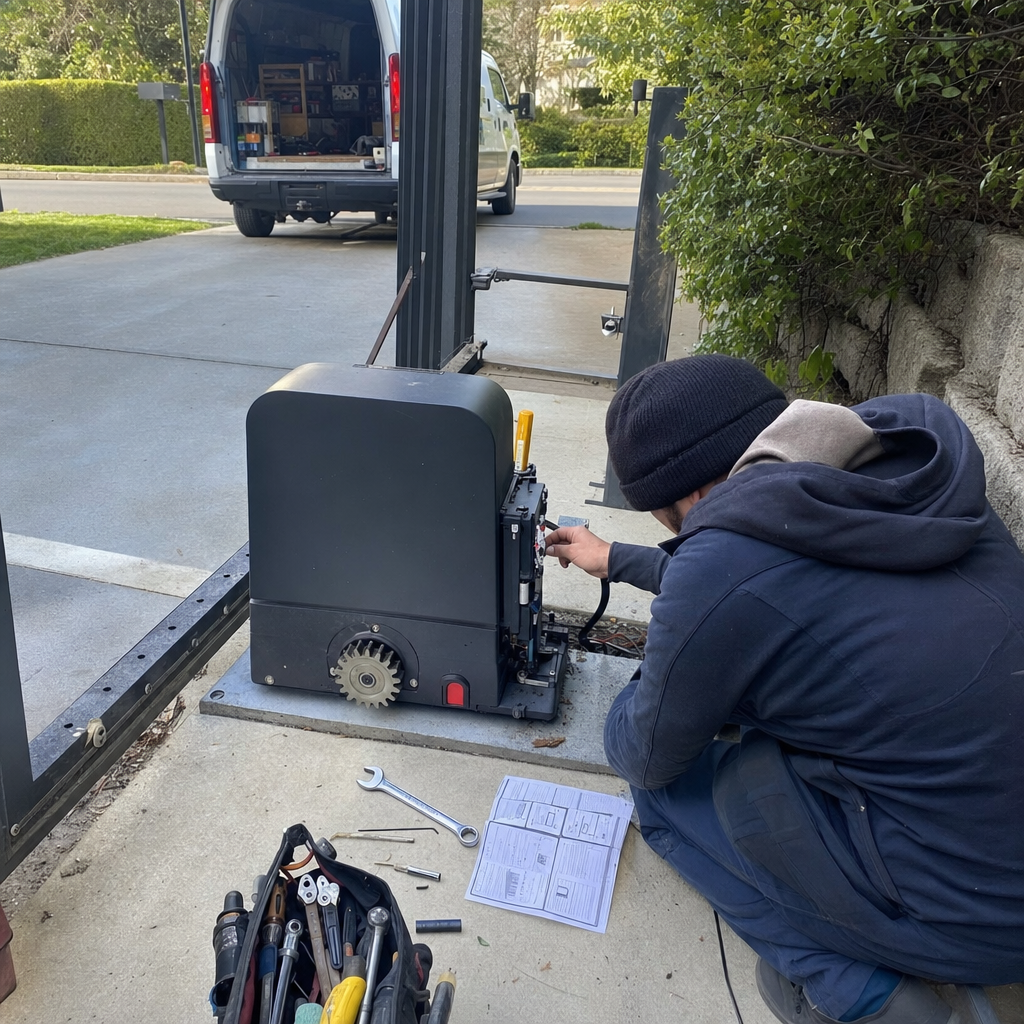
The capacitor itself is a cylinder roughly the size of a Red Bull can, usually mounted adjacent to the motor or inside the control housing. Testing requires discharging it safely (stored voltage can hurt you even with power disconnected) and checking microfarad rating against spec. Replacement takes 10 minutes with the right part.
David’s seen homeowners in Washington quoted full motor replacements for this exact failure. The markup on ignorance is steep. If a technician’s diagnosis stops at “motor’s dead” without mentioning capacitor testing, that’s your signal to ask what they checked upstream.
Safety note: Capacitors store lethal voltage even when power is disconnected. Never attempt removal or testing without proper discharge procedure and insulated tools. This is one of those moments where a trained professional earns their fee entirely through the risk you don’t take.
Brand-Specific Failure Patterns: What You Own Changes Where You Look
Not all gate systems age the same way, and knowing your brand changes your diagnostic starting point. David’s factory familiarity across nine major lines — Gate Motor & Opener service covers LiftMaster, FAAC, BFT, Linear, Viking, Ghost Controls, DoorKing, Elite, and Mighty Mule — means we don’t guess based on what we happen to stock.
Residential DIY brands (Mighty Mule, Ghost Controls): On units 4–7 years old, the control board fails before the motor in roughly 60% of service calls we see in Washington. These boards handle logic, timer functions, and remote pairing — they’re complex for their price point, and moisture intrusion kills them predictably. If your Mighty Mule clicks but won’t move, board failure is more likely than motor failure.
Heavy-duty commercial lines (FAAC, BFT): These Italian-built systems are designed for motor longevity across millions of cycles. The motor typically outlives two board replacement cycles. On a high-cycle HOA entry gate in Washington opening 80+ times daily, we expect 12–15 years from the motor, 5–7 from the board, 3–4 from capacitors. The diagnostic priority shifts accordingly.
Mid-market professional grade (LiftMaster, Elite): More balanced failure distribution. Capacitor issues show up around year 6–8, board issues 7–10, genuine motor wear 10–15 depending on cycle count and maintenance history.
This brand fluency matters because it prevents the “we only work on our brand” limitation that forces premature replacement. We work on the brand you already have — and we know what breaks first on each.
Cycle Count Changes Everything: Washington’s High-Traffic vs. Low-Traffic Gates
The same symptom — motor won’t run — has different root causes depending on how hard your gate works. A residential driveway gate in Kent that opens 6–8 times daily and a commercial entry in Navy Yard that opens 80+ times daily wear through components in entirely different sequences.
| Usage Profile | Typical Annual Cycles | Most Likely First Failure | Expected Motor Lifespan |
|---|---|---|---|
| Residential single-family | 2,000–3,000 | Capacitor (years 6–8) | 12–18 years |
| Multi-family / small HOA | 8,000–15,000 | Board or capacitor (years 5–7) | 10–14 years |
| Commercial / high-traffic | 25,000–40,000 | Capacitor, then board (years 3–5) | 8–12 years |
High-cycle gates in Washington also accumulate more debris in gearboxes — road grit, pollen, the fine silt that blows off the Anacostia in dry spells — accelerating mechanical wear even when electrical components test fine. Maintenance interval matters as much as component quality.
How to Tell If You’re Getting a Real Diagnosis or a Parts Pitch
David’s advice, honed from 14 years of cleaning up after other technicians’ shortcuts: ask exactly what they tested before concluding the motor is failed. The answer tells you everything.
A legitimate diagnostic sounds like: “I measured 118V at the outlet, 116V under load — that’s within spec. Board output to the motor is zero volts in both directions, but the board’s status LED shows normal standby. That points to a failed output relay on the board, not the motor. Here’s the relay replacement versus full board replacement option.”
A parts pitch sounds like: “Yeah, motor’s shot, happens all the time, we can swap it Tuesday.” No numbers, no sequence, no discussion of what was ruled out.
The questions that separate them:
- “What voltage did you read at the motor leads when the opener is triggered?”
- “Did you test the capacitor’s microfarad rating?”
- “What was the motor’s amp draw when you manually bypassed the board?”
- “If the motor is truly failed, why did it work intermittently yesterday?”
If I wouldn’t trust the fix on my own property, I’m not leaving it on yours. That’s been the standard since David started this trade, and it’s why nearly 900 Washington-area customers have left detailed reviews — they remember the explanation, not just the repair.
When the Motor Actually Is the Problem: What Genuine Failure Looks Like
Motors do fail, and when they do, the signs are specific. Bearing seizure produces a loud grinding before total lockup — you’ll hear it coming. Winding failure trips thermal overloads repeatedly after cooldown periods. Gearbox damage from impact (vehicle bump, debris jam) strips teeth and creates visible metal contamination in lubricant.
Genuine motor replacement in Washington typically runs $650–$1,200 for residential swing or slide operators, $1,100–$1,900 for commercial-grade systems, including removal, disposal, and programming. But that price is only justified after upstream components are eliminated with testable evidence — not assumed away.
From the motor to the weld, we handle the full scope. That includes the structural welding and track alignment that some “motor shops” walk past because it’s outside their narrow scope. A motor replacement on a gate with bent track or failing welds is money thrown at symptoms.
FAQs
Most gate motor repairs in Washington range from $180–$550 for electrical issues like board or capacitor replacement, while genuine motor replacement runs $650–$1,900 depending on brand and duty rating. We provide upfront pricing after diagnosis — no surprises, no pressure to replace what can be repaired. Call (855) 275-6878 for a free estimate.
Yes, same-day service is available throughout Washington for most gate motor issues, and David Martinez carries common capacitors, control boards, and diagnostic equipment on every service vehicle. Emergency calls for security-critical gates — commercial properties, HOA entries, or homes where the gate is the primary access control — get priority scheduling. Call (855) 275-6878 to check today’s availability.
Repair is almost always cheaper when the failure is upstream of the motor itself — capacitor, board, or sensor issues typically cost $180–$550 versus $800–$1,900 for full gate motor and opener replacement. We recommend replacement only when the motor is genuinely failed, the system is beyond supported parts availability, or repair costs exceed 60% of replacement. David will walk you through both options with real numbers so you can decide.
Intermittent operation almost always indicates an electrical issue — loose connections, failing capacitor, moisture-corroded board traces, or voltage drop under load — rather than motor failure, which produces consistent symptoms. Washington’s humidity and temperature swings make these gremlins particularly common. The pattern of when it fails (morning cold, afternoon heat, after rain) is itself diagnostic data we use to isolate the root cause.
Get an Honest Diagnosis From Someone Who’ll Stand Behind It
Fourteen years, one trade. That’s the difference between guessing at parts and knowing what fails in what order on the system installed at your property. David Martinez handles every diagnosis personally — no subcontractors, no dispatchers, no incentive to sell you a motor you don’t need.
If your gate motor isn’t working and you’d rather have it looked at by someone who’ll explain exactly what failed and why before quoting a fix, Liberty Bell Gate Repair Washington offers a no-pressure assessment in Washington. Call (855) 275-6878 — estimates are free, and you’ll speak directly with the technician who’ll show up.
Written by David Martinez, Owner & Lead Technician at Liberty Bell Gate Repair Washington, serving Washington, WA.