
Last updated September 3, 2026
Gate Repair Permits, Codes & Inspections in WA: What You Need to Know
Here’s what most Seattle homeowners don’t realize: a gate repair that crosses into “structural alteration” under Seattle’s building code can void your homeowner’s insurance claim — and the definition of “alteration” is narrower and more specific than most contractors will tell you. In 14 years of working gates across King County, we’ve seen simple post replacements turn into $8,000 liability headaches because a previous repair crossed that invisible line without documentation. This guide draws the line clearly between permit-exempt repair and permit-required alteration, explains when adding that automatic opener triggers electrical code requirements, and shows you exactly what paperwork to demand from any contractor who touches your gate — and if you’re weighing whether to hire help, see our How to Hire a Gate Repair Contractor in Seattle: A Step-by-Step Guide.
Quick Answer
Most gate repairs in Washington — replacing hinges, adjusting motors, welding cracks, or swapping openers — do not require a permit, as detailed in The Complete Guide to Gate Repair in Seattle. However, work that changes the gate’s structural support, height, location, or adds new electrical components typically does. In Seattle and unincorporated King County, replacing a gate post or converting from manual to automatic operation usually triggers permit requirements under the Seattle Building Code (SBC) and Washington State Electrical Code.
Table of Contents
- Repair vs. Alteration: The Permit Line Most Contractors Won’t Explain
- How Seattle Building Code Applies to Your Gate
- When Gate Openers Trigger Electrical Permits
- HOA Covenants: The Hidden Layer Above Municipal Code
- Resale & Insurance Risks of Unpermitted Gate Work
- What Documentation to Demand From Your Contractor
- Common Mistakes to Avoid
- When to Call a Professional
- Frequently Asked Questions
Repair vs. Alteration: The Permit Line Most Contractors Won’t Explain
The Seattle Building Code draws a sharp distinction between “repair” and “alteration,” and crossing it without a permit creates documented liability that surfaces at the worst possible moment — usually during a home sale or insurance claim.
Permit-exempt repairs include work that restores your gate to its previously approved condition without changing materials, dimensions, or structural function. Think of these as like-for-like replacements:
- Replacing hinges, latches, or rollers with equivalent hardware
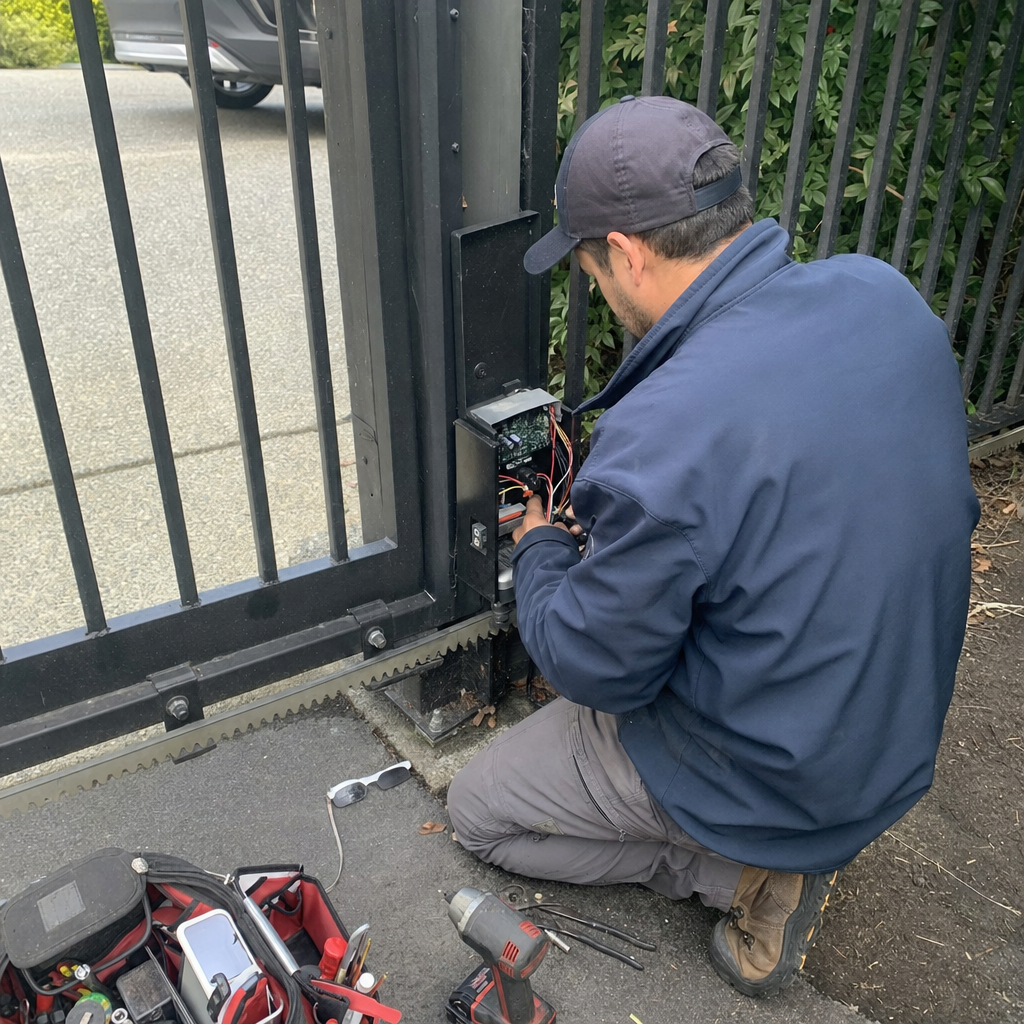
- Adjusting or replacing an existing automatic opener with the same model or equivalent
- Welding cracks in existing gate frames or pickets
- Replacing damaged pickets, boards, or infill panels in kind
- Adjusting gate alignment or travel limits on existing automated systems
- Replacing batteries, photocells, or control boards on existing openers
Permit-triggering alterations change the gate’s approved configuration in ways that affect safety, structure, or property boundaries:
- Replacing a gate post (this is the most common surprise — the post is considered structural support)
- Increasing gate height beyond what was originally approved
- Changing from a manual gate to an automatic gate (new load, new safety requirements)
- Relocating the gate opening to a different point in the fence line
- Changing materials in a way that affects weight, wind load, or visibility (for example, replacing a wood picket gate with solid aluminum in a wind-exposed Seattle hillside location)
- Adding access control systems that require new electrical runs or concrete work
Here’s where Seattle’s enforcement gets specific: the Seattle Department of Construction and Inspections (SDCI) considers post replacement an alteration because the post anchors the gate’s structural integrity against wind loads — and Seattle’s Elliott Bay corridor and Puget Sound exposure zones have documented wind criteria that original permits accounted for. We’ve replaced posts in Magnolia where the original 1990s permit specified concrete depth and rebar ties based on wind exposure calculations that don’t match today’s code. Digging out that old post and pouring new concrete without updated engineering? That’s an alteration.
The practical test we use: if you’re restoring what was there, it’s likely repair. If you’re changing what was there — even to “make it better” — it’s likely alteration. When in doubt, a 15-minute call to SDCI’s permit counter saves months of headaches.
How Seattle Building Code Applies to Your Gate
Seattle operates under the Seattle Building Code (SBC), a locally amended version of the International Building Code that frequently exceeds state minimums. For gate work, three code sections matter most: structural requirements under Chapter 16, electrical provisions under the adopted Washington State Electrical Code, and property line setbacks under the Seattle Land Use Code.
Structural requirements kick in when your gate exceeds 6 feet in height or is part of a retaining wall system — common in Seattle’s Queen Anne, Magnolia, and West Seattle hillside neighborhoods. The SBC requires that gate posts for these applications meet specific embedment depths and concrete specifications, often requiring a geotechnical review in steep-slope areas. We’ve seen DIY post replacements in West Seattle where homeowners used standard 24-inch depth in soils that required 36-inch embedment per geotechnical reports — the gate failed in the first winter storm.
Setback and visibility requirements apply at corners and driveway exits. Seattle’s Land Use Code specifies sight triangle requirements at intersections — your gate cannot obstruct visibility for vehicles exiting your property. A repair that raises gate height or adds decorative elements can inadvertently violate these provisions. In Ballard and Fremont, where narrow lots meet busy arterials, we’ve adjusted gate designs to maintain 10-foot sight triangles at 30-degree angles from the intersection.
Historical and overlay districts add another layer. Capitol Hill, Pioneer Square, and parts of Georgetown have design review requirements that apply even to “repair” work visible from the public right-of-way. Replacing a historic wrought-iron gate with a modern aluminum equivalent — even at the same dimensions — can trigger design review in these districts.
The permit process itself: For straightforward alterations, SDCI offers an “Subject-to-Field-Inspection” (STFI) permit for minor structural work under $5,000. This avoids full plan review but still creates a permit record. Electrical permits for gate openers are typically issued same-day through SDCI’s electrical section or Washington State Department of Labor & Industries for work outside Seattle city limits.
- Determine jurisdiction: Seattle city limits use SDCI; unincorporated King County uses the Department of Local Services, Permitting Division; incorporated cities (Bellevue, Renton, Kent, etc.) have their own building departments.
- Identify the work category: Repair, alteration, or addition — this determines permit type and inspection requirements.
- Submit application with site plan: Even for minor work, a scaled site plan showing gate location relative to property lines and structures is required.
- Schedule inspections: Structural work requires footing/post inspection before concrete pour and final inspection. Electrical work requires rough-in and final inspections.
- Obtain certificate of completion: This document is what future buyers and insurers will look for.
When Gate Openers Trigger Electrical Permits
This is where Washington’s rules get more stringent than most states — and where we’ve seen the most expensive mistakes.
Adding any automatic opener to a previously manual gate requires an electrical permit. Period. The Washington State Electrical Code (WSEC), adopted as Chapter 19.28 RCW, classifies gate opener installation as “electrical equipment” requiring licensed electrical work. This applies whether you’re hardwiring to your home’s electrical panel, installing a dedicated outlet, or even using a “plug-in” opener that connects to an existing exterior receptacle.
The permit requirement exists because automated gates must meet specific safety standards — UL 325 for gate operators — that include entrapment protection, automatic reverse functions, and proper grounding. Seattle’s wet climate adds additional considerations: ground fault protection, corrosion-resistant enclosures, and proper drainage for underground conduit runs. For a full maintenance calendar, see our Seasonal Gate Repair Care for Seattle: Year-Round Homeowner’s Guide.
What triggers the permit:
- Any new electrical circuit or outlet dedicated to gate operation
- Low-voltage wiring runs exceeding Class 2 power limitations (most access control systems exceed this)
- Installation of photocells, safety loops, or edge sensors requiring new wiring
- Upgrading from a 120V residential opener to a 230V commercial-grade system
- Adding battery backup systems that interface with household electrical
What typically does NOT trigger an electrical permit:
- Replacing an existing opener with a like-kind unit using existing wiring and receptacles
- Programming or adjusting existing safety devices without wiring changes
- Replacing remote controls or keypads that communicate wirelessly
- Purely mechanical repairs to gate operators (gear replacement, limit switch adjustment)
Here’s the Seattle-specific wrinkle: SDCI requires that electrical permits for gate openers include a “site safety plan” showing photocell placement and entrapment zones. We’ve worked on installations in Laurelhurst and Windermere where inspectors measured photocell height to within half an inch — the code specifies 4-6 inches above grade for residential swing gates, and they check it.
Brand familiarity matters here. We work on the brand you already have — whether that’s a Ghost Controls residential system common in Seattle’s newer developments, a DoorKing commercial operator in a Capitol Hill multi-family building, or an Elite slide gate at a West Seattle industrial property. Each has specific grounding and safety wiring configurations that inspectors recognize. A contractor who only knows one brand’s wiring diagram can create code violations when adapting to another.
Cost reality: An electrical permit for a residential gate opener in Seattle runs approximately $200-400 depending on circuit complexity. The licensed electrician’s labor adds $800-1,500. Unpermitted work that gets flagged — whether by an inspector on another project, a neighbor’s complaint, or a home sale — triggers retroactive permitting at 2-3x the original cost, plus potential fines.
HOA Covenants: The Hidden Layer Above Municipal Code
Here’s what code-compliant doesn’t mean: HOA-compliant. We’ve completed perfectly permitted, inspector-approved gate repairs in Seattle-area communities that still triggered HOA violation notices — because the covenants, conditions, and restrictions (CC&Rs) imposed stricter standards than city code.
Seattle’s condominium and planned development boom — particularly in South Lake Union, Denny Triangle, and the redeveloped Rainier Valley corridor — created thousands of properties governed by HOAs with gate-specific rules that layer on top of municipal requirements. Common HOA restrictions we encounter:
- Material matching requirements: Cedar gates must be replaced with cedar, not composite or aluminum, regardless of code allowance
- Color restrictions: Specific paint colors from approved palettes — we’ve seen “forest green” rejected because the shade was two Pantone numbers off
- Style consistency: Craftsman-style picket patterns required in historic-designated developments
- Automation prohibitions: Some HOAs ban visible operators or require specific enclosure designs
- Height restrictions below code maximums: Code allows 6 feet; HOA allows 4 feet
- Maintenance timing windows: Restrictions on when noisy work can occur — problematic for welding repairs
The critical point: HOA CC&Rs are private contracts, not public law. Violating them doesn’t create a city code violation, but it does create enforceable civil liability. HOAs can levy fines, place liens, and in extreme cases force removal of non-compliant work — even work that passed city inspection.
In our experience, the most common conflict arises when homeowners upgrade to automatic gates without checking CC&Rs. We’ve installed Mighty Mule systems in Kent and Renton developments where the HOA required operator enclosures matching fence materials — a $400 aesthetic add-on that prevented a $2,000 enforcement action. The permit inspector doesn’t check your CC&Rs; that’s your responsibility and your contractor’s due diligence.
Before any gate work in a governed community: request the CC&Rs from your property management, check for architectural review committee requirements, and get pre-approval in writing. We build this step into our project timeline — it’s 48 hours that saves 48 weeks of dispute.
Resale & Insurance Risks of Unpermitted Gate Work
This is where abstract code compliance becomes concrete financial risk. Unpermitted gate work in Washington creates three specific vulnerabilities: title insurance exceptions, homeowner’s claim denials, and buyer negotiation leverage.
Title insurance and resale: Washington’s standard Form 17 Seller Disclosure requires disclosure of “any work performed without required permits.” Unpermitted gate alterations — even ones that passed informal inspection by a previous owner — must be disclosed. Failure to disclose creates fraud liability and typically voids the title insurance policy’s coverage for that defect. We’ve been called to retroactively permit gate work in Magnolia and Queen Anne where sellers faced $15,000-30,000 price reductions because buyers’ lenders required permit clearance before funding.
Homeowner’s insurance claims: Most policies contain a “concealment or fraud” clause and a “failure to maintain” exclusion. If an unpermitted gate alteration contributes to damage — a post fails and damages a vehicle, an ungrounded opener causes a fire, an improperly installed slide gate injures a visitor — insurers investigate permit history. We’ve reviewed claim denials where the absence of a required electrical permit for an opener installation shifted liability entirely to the homeowner, transforming a covered incident into out-of-pocket exposure.
The specific Seattle risk: Our wet climate accelerates corrosion and wood decay. A post replacement without proper embedment and drainage — common in unpermitted work — fails faster here than in drier climates. When it fails and causes damage, the insurer’s forensic engineer notes the unpermitted work, the inadequate depth, the missing gravel drainage layer that code required. Each element becomes a separate basis for denial.
Documentation that protects you:
- Permit applications and approvals (when required)
- Inspection sign-off certificates
- Contractor’s certificate of insurance
- Product installation manuals with UL 325 compliance verification for openers
- Written warranty from the contractor
- Photographs of completed work (date-stamped)
Keep these records for the life of the improvement plus seven years — Washington’s statute of limitations for construction defect claims.
What Documentation to Demand From Your Contractor
Whether or not your specific gate repair requires a permit, documentation separates professional work from liability exposure. Here’s what we provide on every job — and what you should demand from any contractor who touches your gate.
For permit-exempt repairs:
- Written scope of work describing exactly what was done and what was not done
- Before and after photographs
- Parts list with manufacturer and model numbers
- Written warranty terms (we provide 1-year workmanship on repairs)
- Verification that work was “repair” not “alteration” under applicable code
For permit-required work:
- Copy of permit application with permit number
- Inspection schedule with inspector sign-offs
- Certificate of completion or occupancy (as applicable)
- Licensed electrician’s documentation for electrical components
- Engineering calculations for structural work (when required)
- Final walkthrough checklist with homeowner signature
Red flags that should disqualify a contractor:
- “We don’t pull permits for this kind of work” — on alteration work, this is automatic disqualification
- “The homeowner pulls the permit” — contractors doing alteration work must be named on permits; this is a common evasion tactic
- No written warranty or vague “satisfaction guaranteed” language
- Inability to explain the repair/alteration distinction for your specific project
- No proof of electrical licensing for opener work
David diagnoses it himself on every estimate — and part of that diagnosis is determining permit status before we quote. We’ve walked away from jobs where homeowners wanted us to skip permits to save money. The savings are imaginary; the liability is real and permanent.
From the motor to the weld, our documentation matches our workmanship. 14 years, one trade, and nearly 900 neighbors agree that the paperwork matters as much as the repair. Explore more guides & resources to protect your investment.
Common Mistakes to Avoid
- Assuming “repair” means anything that doesn’t look like new construction. Replacing a rotted post in your Ballard driveway gate is structural alteration under Seattle code, not repair — even if you’re using the same post size.
- Letting an electrician pull the electrical permit without naming the gate contractor. The permit must cover the complete installation; fragmented permits create inspection gaps and liability confusion.
- Ignoring HOA requirements because “the city approved it.” Municipal approval and covenant compliance are separate systems. We’ve seen $8,000 gate installations forced into $3,000 modifications because this step was skipped.
- Accepting verbal assurances about permit status. Every contractor claim about permits should be verifiable through SDCI’s online permit lookup or equivalent jurisdiction database.
- Failing to disclose unpermitted work from previous owners at resale. Washington’s Form 17 disclosure is specific; “I didn’t know” is not a defense against fraud claims.
- Installing battery backup openers without checking electrical permit requirements. Seattle’s 2019 energy code amendments classify certain battery systems as energy storage requiring additional inspection — a surprise to homeowners who assumed “battery = no wiring = no permit.”
- Using general handyman services for gate structural work. Gate-specific structural knowledge — wind loading, post embedment, hardware torque specifications — differs from fence or general carpentry. We’ve corrected failed post installations from general contractors who applied fence logic to gate dynamics.
When to Call a Professional
Call a gate specialist when your project involves structural elements, electrical components, or any uncertainty about permit status. Specifically: post replacement or footing work; conversion from manual to automatic operation; opener replacement in systems older than 10 years; access control integration; or any work in Seattle hillside neighborhoods with geotechnical considerations.
Liberty Bell Gate Repair Washington offers Gate Repair services with free estimates in Seattle — call (855) 275-6878. David Martinez serves as lead technician on every job, bringing 14 years of gate-specific expertise to permit determinations, code compliance, and repair execution. We work on the brand you already have, from Ghost Controls to DoorKing to Elite and beyond, and we document every job to protect your property value and insurance coverage.
Frequently Asked Questions
Most repairs — hinge replacement, opener adjustment, welding cracks, replacing pickets — do not require a permit. However, replacing posts, changing height, converting manual to automatic, or relocating the gate opening typically requires permits under the Seattle Building Code. Call SDCI’s permit counter at (206) 684-8850 to confirm your specific project.
SDCI charges approximately $200-500 for minor alteration permits depending on valuation, plus $200-400 for associated electrical permits. Plan review fees add $150-300 for complex projects. The total permit cost for a typical residential automatic gate installation runs $600-1,200 — significantly less than retroactive permitting or claim denial costs.
Legally, no — Washington State Electrical Code requires licensed electrical work and permitting for any new gate opener installation. Practically, some homeowners do it themselves, but this creates insurance and resale liability that persists for years. If you’re considering DIY, at minimum consult SDCI about permit requirements before starting work.
HOAs cannot stop code-required repairs, but they can enforce aesthetic and material requirements that exceed code minimums. Check your CC&Rs before starting work — many Seattle-area HOAs require pre-approval even for repairs that don’t need city permits. Written approval protects you from future enforcement action.
Search SDCI’s online permit history at seattle.gov/sdci using your property address. For work before 2000, you may need to request microfiche records. Unincorporated King County uses the Department of Local Services permit lookup. We verify permit history as part of our estimate process when structural work is involved.
Washington’s Form 17 requires disclosure of unpermitted work. Failure to disclose can void your title insurance, trigger buyer lawsuits, and force price reductions of $10,000-30,000 or more. If you discover unpermitted work from a previous owner, retroactive permitting is possible but costs 2-3x the original permit fee. Address it before listing — call (855) 275-6878 for a permit assessment.
The Bottom Line
The line between permit-free gate repair and permit-required alteration in Washington is specific, enforceable, and narrower than most homeowners expect. Post replacement, automatic conversion, and electrical work trigger permits in Seattle and King County; like-for-like mechanical repairs typically don’t. HOA covenants add a separate compliance layer. Unpermitted work creates documented liability for insurance claims and property resale that far exceeds any upfront permit cost. Demand written documentation from any contractor, verify permit status through official channels, and when in doubt, consult a gate specialist who understands both the mechanical work and the regulatory framework.
Written by David Martinez, Owner & Lead Technician at Liberty Bell Gate Repair Washington, serving Seattle since 2012.